


 August 3, 2026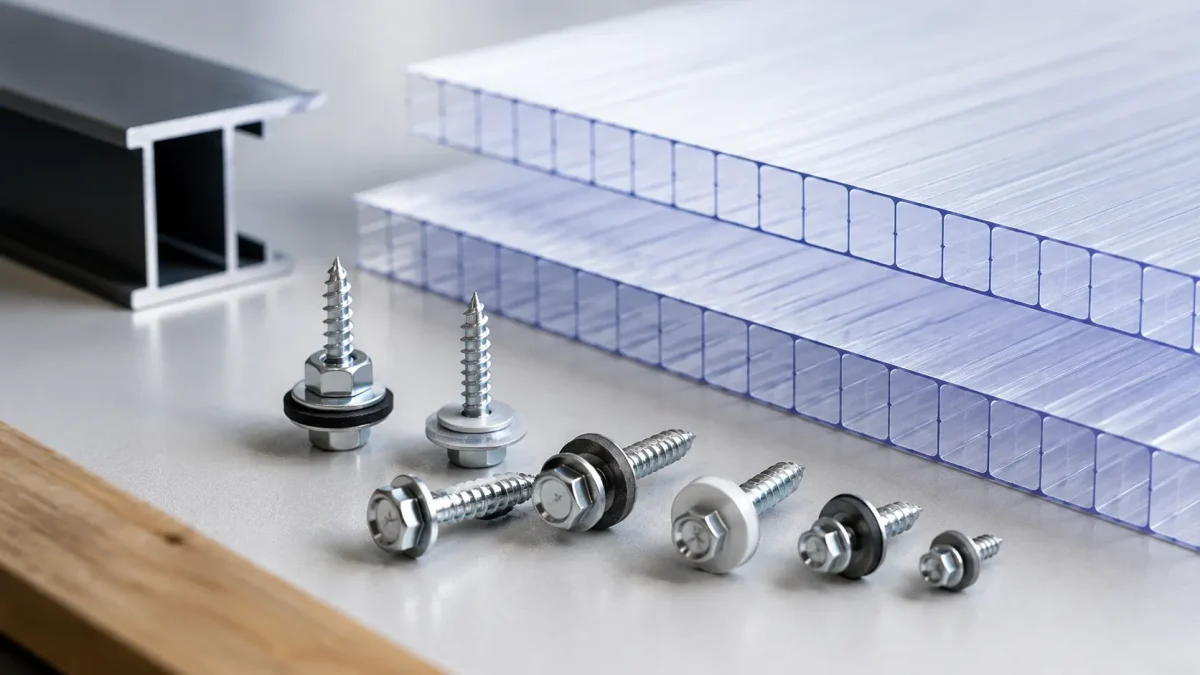
Polycarbonate is lightweight, impact-resistant and easy to process, which is why it is often used for terrace roofs, pergolas, greenhouses, carports, skylights, balcony covers and lightweight partition walls. However, choosing the sheet itself is only part of the work. The durability of the entire structure also depends on the installation method, especially on properly selected screws, washers and profiles.
Which screws for polycarbonate are the best choice? In most cases, corrosion-resistant screws are used, matched to the type of substructure and fitted with a sealing element or a washer that distributes pressure. For outdoor installation, EPDM washers or mushroom washers are especially important because they help reduce the risk of leaks and protect the sheet from point stress.
In practice, the goal is not just to screw the sheet to wood or metal. Polycarbonate expands and contracts under the influence of temperature changes, so it requires proper installation clearance, correct spacing of fixing points and careful tightening. A screw tightened too strongly may deform the sheet, while an incorrectly prepared hole may lead to cracks, leaks or faster wear of the material.
What is polycarbonate and where is it used?
Polycarbonate is a plastic material with high mechanical resistance, good light transmission and broad application possibilities. In construction, it is most commonly available in two basic forms: cellular polycarbonate and solid polycarbonate.
Cellular polycarbonate has an internal channel structure. This makes it lightweight, suitable for roofing and able to provide better insulation properties than a thin solid sheet. It is often chosen for terrace roofs, greenhouses, pergolas, carports, balcony enclosures and other lightweight structures. In this type of application, not only the sheet thickness matters, but also the spacing of supports, the direction of the chambers, edge protection and the fixing method.
Solid polycarbonate resembles glass, but it is lighter and more resistant to impact. It is used wherever greater transparency, aesthetics and resistance to mechanical damage are needed, for example in covers, glazing, canopies, protective elements or technical enclosures.
In both cases, correct installation is very important. Even a high-quality sheet may fail to perform properly if it is fixed with random screws, without washers, without expansion clearance or with excessive pressure.
Why does the choice of screws for polycarbonate matter so much?
Screws for polycarbonate must stabilize the sheet, but they must not block it in a way that prevents the material from working naturally. Polycarbonate expands and contracts under the influence of temperature. In summer, when exposed to strong sunlight, the sheet may heat up and increase in size. In winter or at night, when the temperature drops, the material contracts. This is a normal process that must be taken into account during installation.
If the screw is fitted too tightly, without a proper installation hole, the sheet will not have enough space to move. As a result, microcracks, stress around the fixing point, surface deformation or characteristic noises during temperature changes may appear. The problem is often not visible immediately. It may only become noticeable after several weeks or months of using the structure.
Another important issue is tightness. In roofs, greenhouses and outdoor covers, every fixing point is a potential place for water penetration. That is why a standard screw without a washer is not a good solution. It is much safer to use screws with EPDM washers or special mushroom washers for polycarbonate, which distribute pressure more evenly and help protect the hole.
The third issue is corrosion resistance. Fastening elements work outdoors in contact with moisture, rain, temperature changes and UV radiation. Low-quality screws may start to rust over time, weaken the connection and leave unattractive marks on the surface of the sheets.
Which screws for polycarbonate work best?

There is no single universal screw that will be best for every type of sheet and every structure. The choice depends on whether the sheet is fixed to wood, steel, aluminium, system profiles or another type of substructure. Sheet thickness, format, installation location and exposure to wind, rain and snow also matter.
In most cases, several types of fasteners are worth considering.
Screws with EPDM washers
This is one of the most commonly used solutions for outdoor sheet installation. An EPDM washer helps seal the fixing point and reduces the risk of leaks. It is flexible, which means it handles temperature changes and pressure better than hard, random washers.
Such screws work well for roofs, carports, pergolas, greenhouses and other structures where the sheet is exposed to rain. However, correct tightening is essential. The washer should sit against the surface, but it must not be crushed. Excessive pressure may deform the sheet and lead to cracking around the hole.
Stainless and galvanized screws
For outdoor applications, it is best to choose corrosion-resistant screws. Depending on the conditions, these may be stainless steel screws or properly protected galvanized screws. This is especially important for structures constantly exposed to moisture, such as terrace roofs, balcony covers, greenhouses or canopies above entrances.
Low-quality screws may rust over time, and corrosion not only worsens the appearance of the structure but also weakens the connection. With transparent or light-coloured sheets, rusty stains are particularly visible, so it is not worth saving on fastening elements.
Farmer screws
Farmer screws are often used for lightweight roofing and outdoor structures. They have a wide head and a sealing washer, which means they may work well in selected polycarbonate projects. However, they must be matched to the specific substructure, and it is important to remember that the presence of a washer alone does not remove the need to prepare a proper installation hole in the sheet.
In the case of cellular polycarbonate, it is important that the fixing does not damage the chamber structure or create excessive point pressure. That is why additional mushroom washers or system installation accessories are often used for direct sheet fixing.
Screws for wood and screws for metal
The choice of thread depends on the material to which the sheet is fixed. Different screws are used for a wooden terrace structure and different ones for steel or aluminium profiles. The screw must hold firmly in the base, but its operation must not damage the polycarbonate itself.
With a wooden structure, attention should be paid to screw length, anti-corrosion protection and head type. With a metal structure, the thickness of the profile, type of steel, self-drilling capability and connection resistance to loads are important. In every case, the sheet must have proper expansion clearance.
Mushroom washers for polycarbonate
Mushroom washers are not screws, but in practice they are one of the most important elements of correct sheet fixing. Their purpose is to distribute pressure over a larger surface and reduce the risk of cracking at the fixing point. They are especially useful when the sheet is fixed directly to the structure, rather than only through profiles.
They should be treated as part of the installation system, not as a decorative addition. Properly selected polycarbonate accessories, such as washers, profiles, tapes and sealing elements, affect the tightness, stability and durability of the entire enclosure.
Screws for cellular polycarbonate vs screws for solid polycarbonate
Cellular and solid polycarbonate differ in structure, so different installation details must be taken into account. In both cases, corrosion-resistant fasteners, proper washers and controlled pressure are needed. The main differences concern edge protection, work with chambers and surface aesthetics.
In the case of cellular polycarbonate, it is especially important to protect the channels from moisture, dust and insects. Sheets should be installed with the correct chamber direction, and open edges must be protected with tapes and profiles. Fixing points should not damage the chamber structure. Holes should be made in a way that prevents cracks and leaves enough space for thermal expansion.
With solid polycarbonate, there is no issue with channels, but expansion clearance, even support and careful pressure are still necessary. Solid sheets may look more glass-like, so any installation mistakes, scratches, cracks or over-tightened fixing points will be clearly visible.
If you are installing cellular sheets, the guide how to correctly install cellular polycarbonate may be useful. For solid sheets, it is worth checking the separate rules described in the article how to correctly install solid polycarbonate, because the installation method is not identical.
What should you consider when choosing screws for polycarbonate?
The choice of screws should depend on installation conditions, not only on which product is available at hand. Before buying, it is worth checking several parameters that directly affect the durability and safety of the structure.
- Screw material. For outdoor applications, choose corrosion-resistant elements. Screws should withstand moisture, rain and temperature changes.
- Type of washer. For roofs and other outdoor structures, a sealing washer is very important. EPDM works well in places exposed to water because it helps seal the fixing point.
- Compatibility with the substructure. One screw will be suitable for wood, another for metal and another for a system profile. An incorrectly matched thread may not hold securely or may damage the material.
- Diameter and length. The screw should be long enough to ensure a stable connection with the structure, but it should not be random. A screw that is too short will hold poorly, while one that is too long may complicate installation or interfere with structural elements.
- Pressure distribution. With polycarbonate, pressure must not be concentrated in one small point. That is why washers are used for direct sheet fixing to protect the surface from damage.
- Sheet manufacturer’s recommendations. This is especially important for larger formats, unusual structures, roofs exposed to strong wind or places with large temperature changes.
How to correctly fix polycarbonate with screws?

Polycarbonate installation should be planned before drilling begins. First, a stable, even and clean supporting structure must be prepared. Sheets should not be fixed to a warped, unstable or dirty surface, because this may lead to stress and leaks.
The next stage is the placement of fixing points. Screws should be distributed evenly, according to the design and recommendations for the specific sheet. With larger surfaces, fixing points placed too far apart may cause vibration, noise and wind uplift. Excessively dense fixing is also not ideal, because it increases the number of places potentially exposed to leaks and stress.
Installation holes in polycarbonate should take thermal expansion into account. In practice, this means that the hole in the sheet should be larger than the screw diameter. The exact clearance depends on the type of sheet, its dimensions and manufacturer’s recommendations, but the principle is simple: the screw should not lock the sheet rigidly. The material must have space for natural movement.
Screws should be driven perpendicular to the surface. Angled screwing may damage the sheet, reduce tightness and press the washer unevenly. Tightening should be controlled. Excessive force should not be used, and the screwdriver should not be set to press the washer into the surface as strongly as possible. A correctly installed washer sits against the sheet but does not deform it.
When installing a roof, terrace cover or pergola, the slope must also be considered. Even the best screws will not solve the problem if the structure does not drain water. Standing water increases the risk of leaks, dirt build-up and faster ageing of sealing elements.
A detailed description of the entire process can be supplemented with the step-by-step guide to installing polycarbonate sheets, especially if the structure is to be built independently.
Polycarbonate installation step by step
Correct installation can be divided into several stages. This order of work reduces the risk of errors and makes it easier to control the whole process.
- Prepare the supporting structure. Check whether it is stable, clean, even and matched to the sheet dimensions. Remove sharp edges, dirt and elements that could damage the polycarbonate.
- Plan the sheet layout. Determine the slope direction, joint placement, profile position and fixing points. With cellular polycarbonate, pay attention to the direction of the channels.
- Cut the sheets according to the design. Use tools suitable for plastics and work carefully to avoid rough or damaged edges.
- Protect the edges. In the case of cellular sheets, use appropriate tapes and profiles to limit the access of moisture, dust and insects to the channels.
- Mark the fixing points. Keep the correct distance from the sheet edges and follow the spacing recommended by the manufacturer.
- Make installation holes. The holes should be larger than the screw diameter to allow the material to work under temperature changes.
- Install the sheets. Drive screws perpendicular to the surface, use washers and do not over-tighten them.
- Check tightness and pressure. Washers should sit evenly against the surface, but they must not be flattened or pressed into the sheet.
- Remove the protective film after the work is finished. Do not leave it in the sun for too long, because it may become harder to remove from the surface.
- Check the structure after the first weather changes. After strong wind, heavy rain or large temperature fluctuations, it is worth checking whether the fasteners are working correctly.
Most common mistakes when installing polycarbonate
The most common mistake is over-tightening screws. Many people assume that stronger pressure means better tightness and stability. With polycarbonate, the opposite is true. Excessive pressure may damage the surface, deform the sheet and lead to cracks around the hole.
The second mistake is the lack of expansion clearance. Polycarbonate should not be fixed as rigidly as a metal or wooden element. If the holes are too tight, the material has no space to expand and contract. This is one of the main causes of stress and damage.
The third mistake is using random screws. Standard wood screws without a washer and without proper corrosion protection are not the best choice for sheets used outdoors. They may fail to provide tightness and may rust over time, weakening the connection.
The fourth mistake is omitting washers. A screw without a proper washer concentrates pressure on a small surface. With plastic material, this may lead to local damage, leaks or deformation.
The fifth mistake is incorrect placement of fixing points. Screws should not be placed too close to the edge or distributed randomly. Drilling too close to the edge increases the risk of cracking, while uneven spacing may cause local overloads.
The sixth mistake is failing to protect the edges of cellular sheets. If the channels remain open, moisture, dust and insects may enter them. Over time, this worsens the appearance of the sheets and may reduce the aesthetics of the entire structure.
Can polycarbonate be installed without pre-drilling?
It depends on what exactly is meant by installation without pre-drilling. Some screws have a self-drilling or self-tapping function, so they may make fixing to the substructure easier. However, this does not mean that a polycarbonate sheet can always be safely screwed down without preparing installation holes.
Thermal expansion is very important in the case of polycarbonate. That is why, when sheets are fixed directly, holes larger than the screw diameter are usually made. This allows the sheet to move, and the screw does not block it too tightly. This is especially important with large sheets, outdoor roofs and places exposed to strong sunlight.
A safer rule is this: the screw may make work with the substructure easier, but the polycarbonate sheet itself requires installation with expansion clearance. If the sheet manufacturer provides specific hole diameters, fixing spacing or washer instructions, these recommendations should be followed.
What accessories are needed besides screws?
Screws alone are rarely enough for the correct construction of a polycarbonate structure. Depending on the type of enclosure, connecting profiles, closing profiles, protective tapes, mushroom washers, seals and finishing elements may also be needed.
Connecting profiles help join neighbouring sheets in a stable and aesthetic way. Closing profiles protect edges, which is especially important with cellular polycarbonate. Tapes protect channels from dirt and moisture. Washers improve pressure distribution at the fixing point.
The choice of accessories should be consistent with the sheet thickness and type of structure. Different elements will be needed for a small cover, different ones for a large terrace roof and different ones for a greenhouse or balcony enclosure. That is why fixing should be treated as a system: the sheet, profiles, seals and screws should work together.
Conclusion
The choice of screws for polycarbonate should not be random. The type of fastener affects not only the appearance of the structure, but also its tightness, durability and resistance to changing weather conditions. The safest solution for outdoor installation is to use corrosion-resistant screws together with sealing washers or mushroom washers. This type of connection helps reduce the risk of leaks, point stress and sheet damage.
The most important point is that the screw must not lock the sheet rigidly. Polycarbonate changes its dimensions under the influence of temperature, so installation holes should provide expansion clearance. Fixing that is too tight, excessive tightening or the lack of a washer may lead to cracks and deformation, even if the sheet itself is of good quality.
During installation, the entire structure should be treated as a system: the sheet, profiles, washers, tapes, seals and screws must be compatible with one another. This makes a roof, cover, greenhouse or pergola stable, aesthetic and less prone to typical operational problems.
If you are planning to build a polycarbonate structure, choose not only the right type of sheet, but also a complete set of installation accessories. At Oteko, you can find cellular polycarbonate, solid polycarbonate, profiles, washers and elements needed for durable and aesthetic installation.