


 August 3, 2026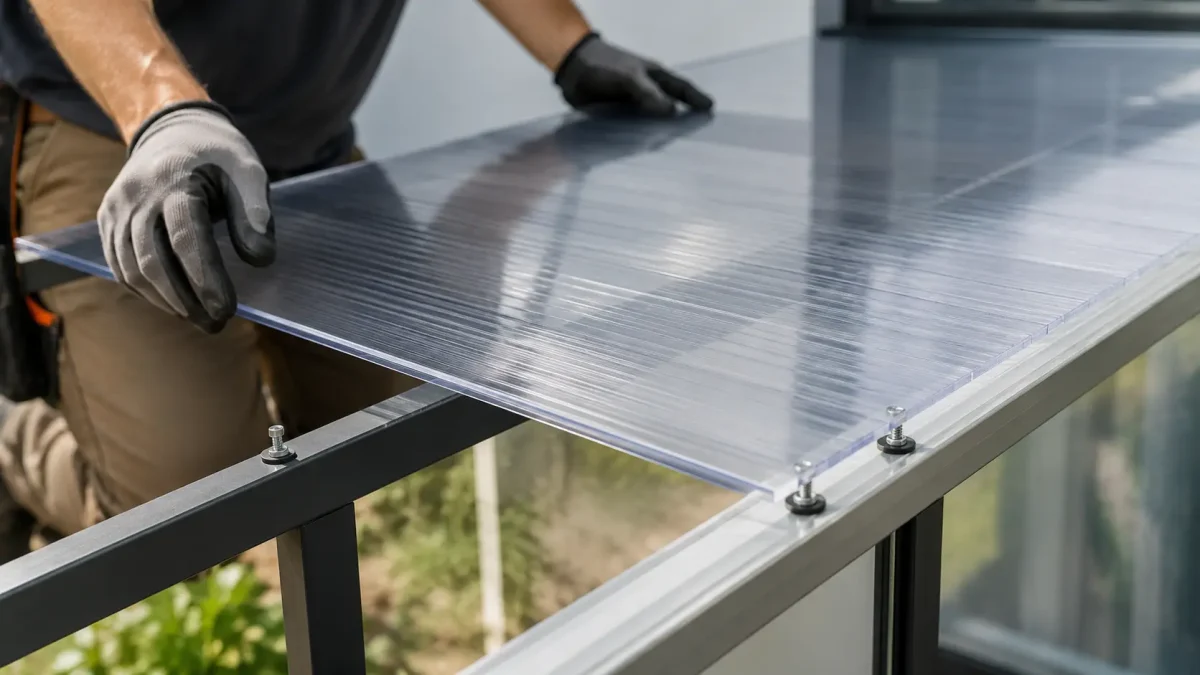
Are you planning to arrange your outdoor space and build a patio roof that effectively protects your garden furniture from sun and rain, increases comfort around your home, and looks modern and lightweight at the same time? In such applications, solid polycarbonate sheets are an excellent solution – durable, safe, and easy to work with. Below you will find a detailed overview of the properties, applications, and installation principles that will help you create a stable, watertight, and aesthetically pleasing roof for many years.
Solid polycarbonate – properties and characteristics
Solid polycarbonate for roofing is a premium-grade material among transparent plastics. Its greatest advantage is extremely high resistance to impact and cracking. In practice, this means the sheet can withstand hail, accidental tool impacts, and gusts of wind carrying small branches or gravel – without shattering like glass. As a result, a patio roof made of solid polycarbonate is safe both for household members and for people staying underneath the structure.
Another important feature is its low weight compared to glass. Lighter infill means lower requirements for the supporting structure, easier transport, and faster installation. At the same time, very good transparency and an elegant visual effect are maintained, which is especially important for patios, pergolas, and winter gardens – the roof does not visually overwhelm the building.
Solid polycarbonate performs well in changing temperatures and remains stable in typical outdoor conditions. It also provides good acoustic insulation – during rainfall, noise is usually less noticeable than with many other roofing materials. It is also worth noting the UV filter, which limits material degradation caused by sunlight and helps maintain its aesthetic appearance for longer (reduced tendency to yellowing or clouding). For patio users, this also means more pleasant shade and less heat build-up under the roof.
Solid polycarbonate – applications
Thanks to its durability and resistance to external factors, solid polycarbonate is chosen wherever safety and longevity are essential. In practice, it is used for technical covers, protective glazing, screens, and infill panels, as well as in residential construction – primarily for roofing and glazing.
In the context of home and garden use, the most common applications include:
- patio and pergola roofing,
- entrance canopies and porch roofs,
- winter gardens and seasonal enclosures,
- window infill and skylights,
- wind screens and patio partitions.
This material makes it possible to achieve a “light roof” effect that provides protection without blocking natural daylight. This is particularly important when the patio adjoins the living room – an overly dark roof can significantly reduce indoor comfort.
Which solid polycarbonate for roofing?
When choosing sheets for roofing, it is best to consider three factors: color, thickness, and load conditions (snow and wind).
Color and user comfort
- For maximum transparency and a neutral appearance, the most common choice is the clear sheet variant.
- If more pleasant shade, reduced glare, and lower heat build-up are priorities, tinted options work well, such as smoked bronze for patios or graphite patio roofing.
- For modern, contrasting designs, especially with black frames and dark joinery, black solid polycarbonate is often chosen.
Sheet thickness
For most residential patio roofs, sheets with a thickness of 6–8 mm work very well. The higher the loads in a given area (snow, wind) or the larger the spans between supports, the more justified it is to choose a thicker sheet or densify the supporting structure.
Local loads
In Poland, snow and wind load zones apply. In practice, this means that two patios with identical dimensions but located in different regions may require different rafter spacing and sheet thickness. The safest approach is to select parameters that provide a structural safety margin for the winter season.
How to store solid polycarbonate?
Proper storage of transparent sheets has a real impact on their appearance after installation. Solid polycarbonate should be stored:
- in a shaded place, away from direct sunlight,
- on a flat, stable surface (without point supports that could deform the sheet),
- preferably in a horizontal position, secured against slipping,
- with the protective film left in place until installation.
Transparent sheets can act like a lens – under strong sunlight, heat can accumulate, leading to softening of the protective film, adhesion, and difficult-to-remove marks. For this reason, storing sheets in direct sunlight should be avoided.
Types of polycarbonate roofing
Several structural solutions are commonly used, which determine the method of sheet installation:
- Single-slope – simple construction and effective water drainage.
- Double-slope – classic appearance, greater ridge height.
- Arched – visually striking, requires matching the bending radius.
- Steel structures – very stable, suitable for larger spans.
- Aluminum structures – corrosion-resistant, lightweight, aesthetic.
- Wooden structures – popular and easy to build, require impregnation.
In every variant, correct slope, stable fixing, and solutions that limit vibration transfer and thermal movement of the sheet are essential.
Before installing solid polycarbonate
The preparation stage determines the durability of the roof. Before starting work:
- take accurate measurements and prepare a structural drawing (width, length, projection, height at the wall and at the edge),
- plan a slope that ensures efficient water and meltwater runoff,
- consider water drainage (gutter, drip edge, runoff direction),
- plan fixing points to avoid drilling holes “by eye”,
- check that the structure has sufficient rigidity (a structure that is too flexible will move in the wind and stress the connections).
It is worth remembering that a roof is exposed to significant forces: wind pressure, wind suction at edges, periodic snow loads, and cyclic thermal movement. The better the design, the lower the risk of leaks and cracking around fixing points.
How to install solid polycarbonate?
Installing solid polycarbonate sheets is straightforward but requires precision. The general workflow is as follows:
- preparing and leveling the supporting structure,
- cutting sheets to size,
- preparing seals and profiles,
- placing sheets on rafters,
- fixing sheets using profiles or screws with washers,
- securing edges,
- final removal of the protective film.
Solid polycarbonate is easy to work with and does not cause problems during cutting, but it is important to avoid methods that overheat the edges. A clean, straight edge makes sealing easier and improves the final appearance.
What do you need to install solid polycarbonate?
To ensure a durable and watertight installation, prepare the following accessories:
- spacer washers – maintain correct spacing and reduce stress,
- screws with seals – ensure stable and tight fixing,
- top and bottom profiles – evenly press the sheet and improve aesthetics,
- seals for rafters and profiles – reduce leaks and vibrations,
- closing profiles – protect edges and improve water runoff.
Well-chosen seals and profiles are just as important as the sheet itself – they are responsible for tightness and minimizing the risk of micro-cracks caused by thermal movement.
Roof structure – what rafter spacing for polycarbonate?
Rafter spacing affects sheet deflection, wind stability, and tightness at joints. In many projects, spacing of around 60–70 cm is used, but this is only an approximate value. With higher snow loads or larger roof spans, it is reasonable to:
- reduce rafter spacing,
- use a thicker sheet,
- add additional supports or stiffening members.
Excessive spacing may cause the sheet to “work” during strong winds and temperature changes, which over time stresses fixings and seals.
Fixing solid polycarbonate to the structure
After preparing the structure and accessories, proceed with installation in an orderly sequence:
- fit seals into profiles and cut them to size,
- partially peel off the protective film only at edges and fixing zones to avoid scratching the surface,
- place seals on rafters, ensuring continuity and even contact,
- position the sheet, align it correctly, and maintain installation clearances,
- fix the sheet using profiles or screws with washers, without overtightening (the sheet must be able to move),
- secure free edges with closing profiles to allow proper water runoff,
- finally remove the protective film from the surface.
As a solid, single-layer sheet, solid polycarbonate does not require solutions typical for multiwall sheets, but edges should still be protected in a way that improves drainage and aesthetics.
Safe cleaning methods – keep your roof in perfect condition
Proper care helps maintain transparency and appearance over time. For cleaning, use:
- warm water,
- a soft cloth or microfiber,
- mild cleaning agents (without abrasives).
Avoid rough sponges, scouring powders, and aggressive chemicals that can dull the surface or leave micro-scratches. For heavier dirt, rinse the surface with water first and then wipe it – this reduces the risk of dragging sand particles across the sheet.
Solid polycarbonate installation – what else is worth remembering?
- Maintain an expansion gap: the sheet expands and contracts with temperature, so fixing holes must allow minimal movement.
- Do not drill too close to the edge: this reduces the risk of stress and cracking around fixings.
- Avoid processing methods that cause overheating: clean, straight edges make sealing easier.
- Remove the protective film at the right time: removing it too early increases the risk of scratches, too late – the risk of film adhesion after sun exposure.
- Ensure proper slope and drainage: even the best material will not compensate for a poorly designed roof that traps water near the wall or joints.
A properly built solid polycarbonate roof combines durability, safety, and aesthetics. If you choose the right option from the solid polycarbonate category and match the color to your needs (transparency, shade, modern look), you gain a solution for many years — which is why, when building a patio or pergola, it makes sense to choose your polycarbonate from us to immediately select the right variant and parameters for your structure.