


 August 3, 2026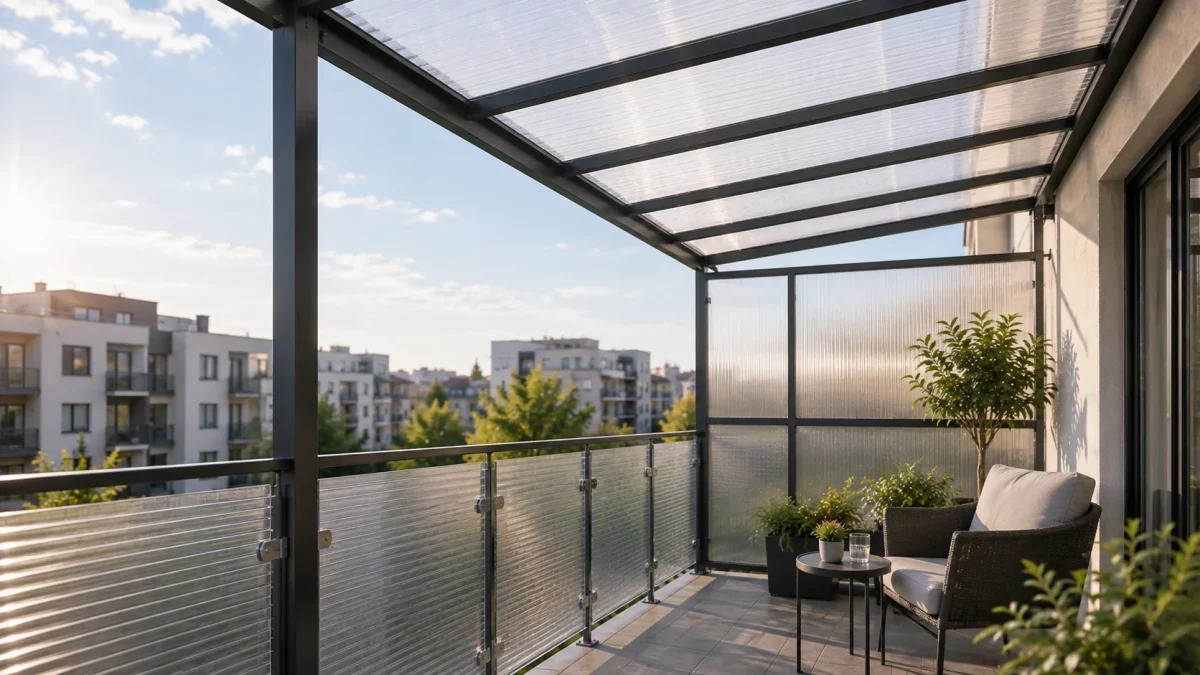
Polycarbonate can be a practical material for protecting a balcony from wind, precipitation, intense sunlight and the view of people outside. It is lightweight, resistant to accidental impacts and considerably easier to process than traditional glass. However, this does not mean that every sheet will be suitable for every balcony.
The durability and comfort of using the screen depend primarily on the type of polycarbonate, its thickness, the method of support and the quality of the mounting structure. A small loggia enclosed by walls requires different parameters from a balcony on a high floor that is constantly exposed to strong gusts of wind.
Polycarbonate sheets can be used as side screens, balustrade infill, lightweight roofing or elements of a partial enclosure. In many cases, they provide an alternative to glass, particularly when low structural weight, mechanical resistance and the ability to adapt the sheets without using heavy equipment are important.
Before starting work, however, technical issues are not the only factors that need to be analysed. In apartment buildings, a permanent balcony enclosure may affect the appearance of the facade or interfere with shared elements, so prior approval from the housing community or cooperative may sometimes be required.
When is polycarbonate a better choice for a balcony than glass?
Polycarbonate is worth considering primarily when the planned screen needs to be lightweight, resistant to damage and easier to install than glazing. Toughened or laminated glass provides an elegant appearance and high rigidity, but it usually requires a heavier structure, very precise measurements and professional installation.
On balconies in apartment blocks, the weight of the material and the way it is fixed are often crucial. A lighter sheet places less load on the existing balustrade or an additional frame. At the same time, polycarbonate does not break apart on impact like ordinary glass, which reduces the risk of sharp fragments.
Screens made from this material can protect the balcony from:
- side gusts of wind;
- rain and wind-blown snow;
- dust and pollution from the street;
- excessive sunlight;
- direct views from neighbouring balconies or buildings.
Polycarbonate also provides a wide range of options for controlling the transparency of the screen. Clear sheets preserve the flow of light and an open view, while milky, smoked or multi-wall variants reduce visibility from outside. This is important on the ground floor, beside a busy street or in developments where balconies are located close together.
Possible disadvantages must also be considered when choosing the material. A large, thin panel without adequate support may vibrate in the wind, resonate or transfer noise to the balustrade. The durability of the enclosure therefore depends not only on the properties of the material but also on its thickness, the spacing of the fixings, the size of individual sections and the rigidity of the entire structure.
Solid or multi-wall polycarbonate for a balcony?
Two main types of sheet are used for balcony screens – solid and multi-wall polycarbonate. Both solutions are lighter than glass and resistant to impact, but they differ in structure, transparency, insulation, appearance and installation requirements.
Solid polycarbonate has a uniform structure and can visually resemble glass. It is suitable for screens where high transparency, aesthetics and the absence of visible internal channels are important. It is used, among other applications, as balustrade infill, a side panel or a transparent element of a partial enclosure.
Multi-wall polycarbonate consists of several layers connected by internal partitions. This structure reduces the weight of the sheet and improves its insulation properties. The chambers diffuse light, so the material does not provide as clear a view as a solid sheet. However, it can work well for larger screens, lightweight canopies and enclosures where privacy and reduced heat loss are priorities.
The most important differences can be compared in the table below:
| Criterion | Solid polycarbonate | Multi-wall polycarbonate |
| Weight | It is considerably lighter than glass, but usually heavier than a multi-wall sheet of similar dimensions. | It has a low weight, which makes it easier to create larger screens and install them on lightweight structures. |
| Price | It usually costs more, particularly in the case of thicker sheets with high transparency. | It is usually less expensive, which is why it is often used to cover larger areas. |
| Transparency | It provides high transparency and an appearance similar to glass, especially in the clear version. | The chambers diffuse light and limit clear visibility through the sheet. |
| Insulation | It provides lower thermal insulation because it has a uniform structure without internal chambers. | It provides better insulation thanks to its layered structure and the air contained inside the chambers. |
| Impact resistance | It is distinguished by very high resistance to accidental impacts and mechanical damage. | It is also resistant to impact, but the rigidity of the sheet depends on its thickness, construction and the direction of the chambers. |
| Rigidity | It depends on the sheet thickness, panel size and the number and spacing of support points. | It depends on the thickness, number of walls, chamber arrangement and the method of fixing it within the structure. |
| Aesthetics | It provides an elegant, minimalist appearance suitable for modern balconies and visible facade elements. | It has a more technical appearance because of the visible structure of the internal channels. |
| Balcony applications | It works well as balustrade infill, a side screen, a transparent protective panel or an element of an aesthetic enclosure. | It can be used for larger screens, lightweight canopies, partial enclosures and screens that increase privacy. |
The choice should depend on the function of the screen. When transparency and a glass-like appearance are priorities, a solid sheet is usually the better option. If low weight, diffused light, partial restriction of visibility and insulation are more important, a multi-wall sheet may be a practical solution.
Colour also matters. A transparent sheet preserves the natural light on the balcony. Variants such as clear POL CRYSTAL, milky or smoked can change the amount of light and the level of privacy. For screens intended to restrict visibility, options such as milky opal solid polycarbonate or smoked bronze multi-wall polycarbonate may be considered.
Which polycarbonate should be chosen for different types of balcony?
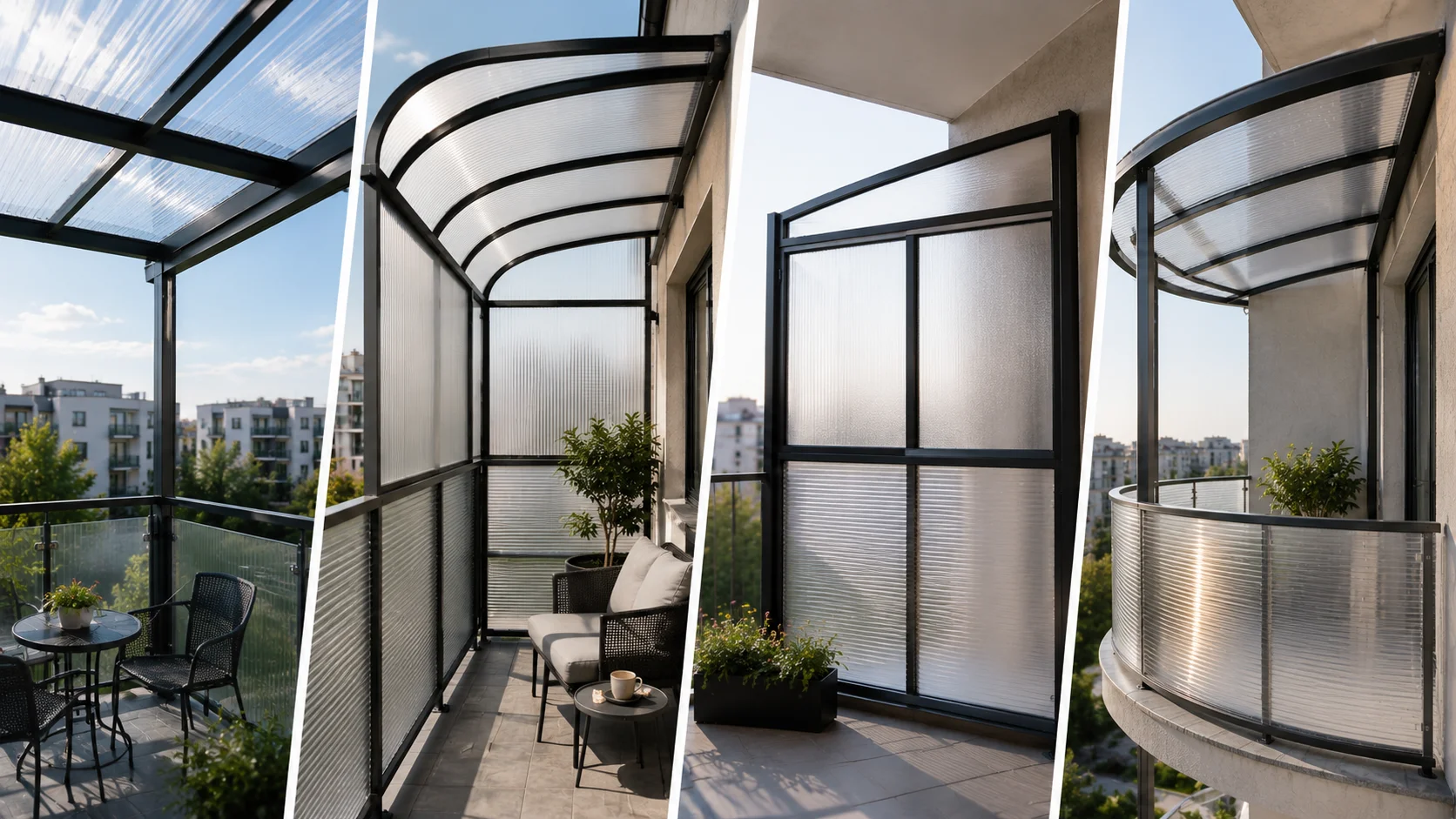
The selection of a sheet should begin with an assessment of the installation location. The price of the material should not be the only criterion. More important factors include the height of the balcony, exposure to wind, the width of each panel, the level of sunlight and the structure to which the screen will be fixed.
The intended purpose of the enclosure is also important. A small panel protecting the side of a balcony behaves differently from a full screen installed along the entire length of the balustrade. The larger the surface exposed to wind, the more important the sheet rigidity, number of supports and quality of the profiles become.
A high balcony heavily exposed to wind
On high floors, panels are exposed to significant wind loads. A sheet that is too thin may bend, vibrate and generate noise. Vibrations can be transferred to the balustrade, wall or frame, making even a durable material inconvenient in everyday use.
In these conditions, appropriately thick solid polycarbonate or a more rigid multi-wall sheet placed within a stable frame is often used. However, it is not possible to specify one universal thickness without knowing the panel dimensions, support spacing and local loads. For larger screens, the structural design should be discussed with a contractor.
The sheet should be supported around its edges and, where necessary, in the central area as well. Appropriately selected aluminium profiles for polycarbonate, seals and fixings that allow the material to expand and contract can be used for installation.
On very windy balconies, a full enclosure is not always the best solution. Sometimes it is sufficient to protect the side from which the wind most frequently blows. A smaller panel can effectively reduce discomfort while limiting the surface exposed to air pressure.
A small, sheltered balcony or loggia
In a loggia or on a balcony enclosed by walls, the effect of wind is usually lower. This makes it possible to place greater emphasis on appearance, privacy and the amount of transmitted light.
If the interior of the apartment needs to remain well lit, a transparent solid sheet may be suitable. For balconies facing a neighbouring building, a milky, smoked or multi-wall material that limits direct visibility may prove more practical.
With a small area, completely blocking airflow should be avoided. An airtight enclosure may encourage condensation, especially when laundry is dried on the balcony or when it adjoins a kitchen or bathroom.
The screen should therefore provide protection from wind and precipitation, but it must not accidentally turn the balcony into an unventilated space. Ventilation openings, structural gaps or a partially open panel arrangement help reduce the risk of condensation.
Full balcony enclosure and side screens – what is the difference?
A full enclosure can significantly reduce the effects of rain, snow, wind and pollution. At the same time, it requires a more carefully prepared design. Loads, water drainage, thermal movement of the sheets, air circulation and the method of connecting the structure to the building must all be considered.
A side screen is a simpler solution. It can reduce gusts from one direction, separate the balcony from a neighbouring space or increase privacy without enclosing the entire perimeter. It usually requires fewer components and has less effect on the appearance of the facade.
The scope of work should correspond to the actual problem. If the balcony is uncomfortable mainly because of side winds, a full enclosure may be unnecessary. If the aim is to create a space protected for most of the year, a more extensive structure will be required, and its construction will need a detailed design.
Does a polycarbonate balcony enclosure require approval from the housing community?
In an apartment building, the regulations of the housing community or cooperative should be checked before a permanent screen is installed. This applies particularly to work that affects the appearance of the facade or requires drilling into an external wall, ceiling, balustrade or balcony slab.
Although the balcony is used by the owner of a particular apartment, some of its structural and external elements may form part of the shared property. For this reason, the fact that work is being carried out within a privately used balcony does not automatically mean that it can be completed without approval.
Lightweight, removable screens that do not interfere with shared elements and do not permanently alter the appearance of the facade are usually the least problematic. A full enclosure, permanent panels screwed to the balustrade or a structure connected to the building wall may be assessed differently.
Before ordering materials, check:
- the provisions of the housing community or cooperative regulations;
- the rules concerning changes to the appearance of the facade;
- the status of the elements to which the structure will be fixed;
- any administrative requirements;
- the permitted colours, materials and forms of screens.
Some buildings have uniform rules for balcony enclosures. The housing community may require a specific sheet colour, type of profile or the same arrangement as in the other apartments.
Procedures resulting from construction law are a separate issue. Not every small screen requires a permit or notification, but in the case of permanent interference with the building structure, a large installation or a solution affecting safety, assumptions should not be relied upon. The scope of the requirements should be confirmed with the relevant authority or a suitably qualified professional.
A short description of the planned enclosure should be attached to the approval request, including:
- the type and colour of polycarbonate;
- the approximate panel dimensions;
- the fixing method;
- the point of connection to the existing structure;
- information on whether the screen will be permanent or removable;
- a simple drawing or photograph showing the planned scope of work.
For a detached house, the formalities are usually less extensive, but safety, local restrictions and the effect of the structure on the facade and load-bearing elements must still be considered.
How to install polycarbonate on a balcony step by step?
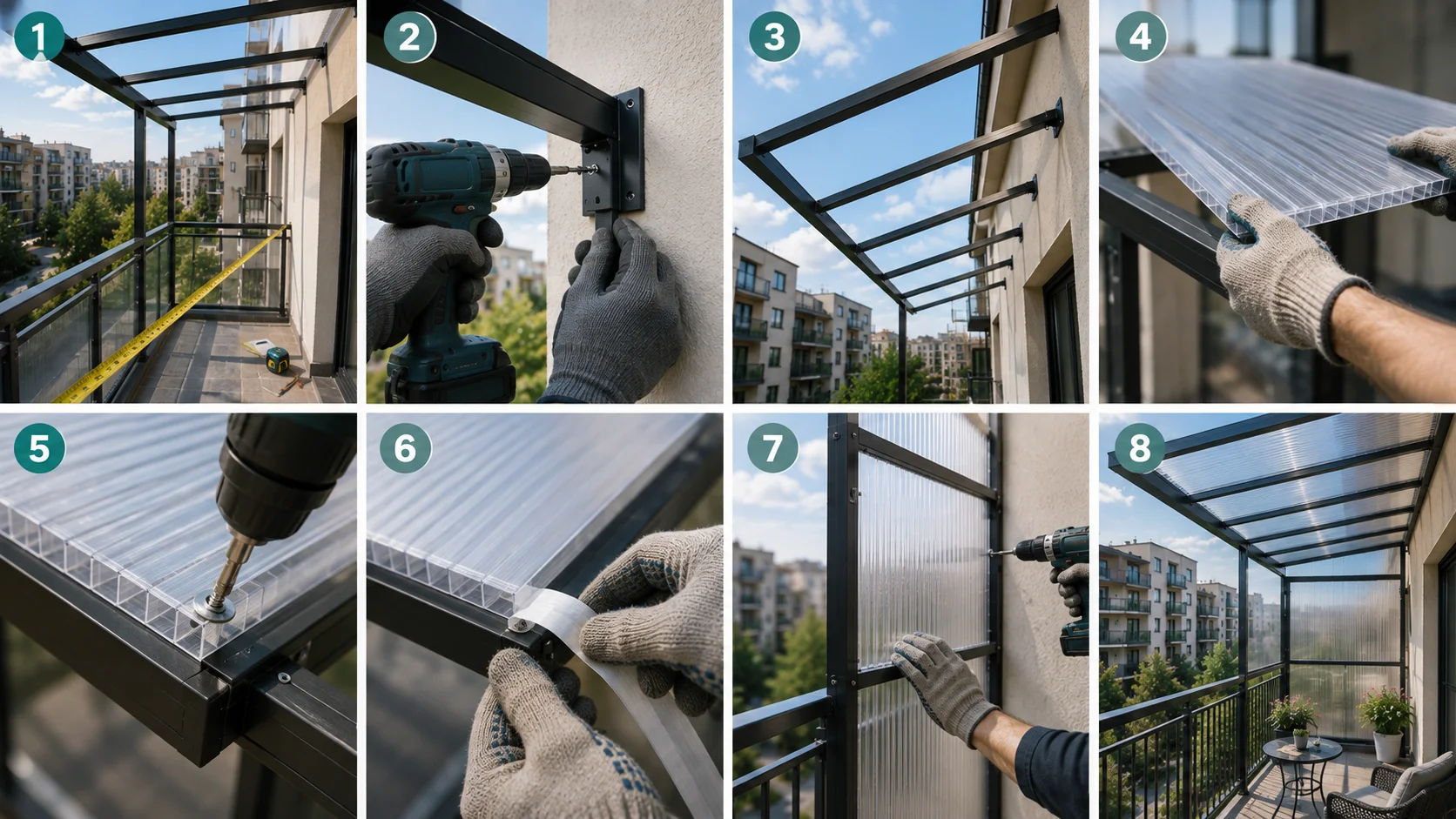
Correct installation begins with the design of a stable structure. The sheet itself, even when sufficiently thick, cannot replace a frame or proper support. On a balcony, vibrations of the balustrade, temperature changes, wind pressure and limited working space must all be considered.
Before starting work, determine whether the polycarbonate will be used as a side screen, balustrade infill, a canopy or part of a larger enclosure. The panel dimensions, thickness, support spacing and method of protecting the edges depend on its function.
Measuring and preparing the structure
The installation area should be measured at several points. Walls, recesses and balustrades do not always have perfectly square angles, so a single measurement may result in the sheet being cut incorrectly.
The panel should not be made to fit the exact dimensions of the space between the profiles. Polycarbonate changes its dimensions under the influence of temperature, so an expansion gap must be maintained. A lack of space for expansion may cause the sheet to bulge, press against the profiles and develop stress around the fixings.
The structure must be level, stable and resistant to corrosion. Before fixing the panel to the balustrade, its technical condition should be assessed. A loose or corroded balustrade will not provide a suitable base for an additional surface exposed to wind.
For larger sheets, support around the perimeter is more beneficial than fixing the material at only a few points. A complete set of components can be selected from the range of polycarbonate accessories.
Cutting and trimming the sheets
The cutting method should be matched to the type and thickness of the material. A solid sheet must be properly secured to reduce tool vibration and obtain an even edge. With multi-wall sheets, maintaining the correct direction of the channels is also important.
After cutting, all dust and shavings must be removed thoroughly. Contamination left inside the chambers is difficult to remove after the edges have been sealed and may worsen the appearance of the finished screen.
The open ends of a multi-wall sheet must be protected with appropriate tapes and profiles. This limits the entry of dust, insects and moisture. Detailed processing rules are described in the guide explaining how to cut multi-wall polycarbonate without cracking.
Fixing – profiles, seals and expansion gaps
Profiles stabilise the edges, distribute pressure and limit point loads. They also improve the appearance of the enclosure and reduce the risk of vibration in the wind.
The sheets must not be locked in a way that prevents thermal movement. Installation holes should allow for the expansion of the material, and screws must not be tightened so firmly that they deform the surface.
Seals separate the polycarbonate from metal or other hard structural components. They help reduce knocking, leaks and panel movement. However, the entire enclosure should not be sealed without leaving the required ventilation.
When joining several sheets, the profile must be selected according to the structural arrangement. Detailed information about profiles, tapes and common problems is provided in the guide on how to join multi-wall polycarbonate.
UV-protected side – how to avoid mistakes
Sheets intended for outdoor use may have a UV-protective layer on one or both sides. Before installation, the manufacturer’s markings on the protective film must be checked.
The UV-protected side should face outwards. Installing it the wrong way round may accelerate the deterioration of the material’s appearance and properties, particularly on south- and west-facing balconies.
The protective film should not be removed before cutting and fixing because it protects the surface from scratches. It must, however, be removed after the work is completed. If left in the sun, it may adhere strongly to the sheet over time.
Additional information about solid sheets can be found in the guide on how to install solid polycarbonate correctly. For multi-wall sheets, the installation guide for multi-wall polycarbonate sheets will also be useful.
The most common mistakes when installing polycarbonate on a balcony
Problems with the screen often do not appear immediately after installation. They may only become visible during the first period of hot weather, strong wind or prolonged rainfall. They are most commonly caused by an unsuitable match between the material and the conditions or by structural errors.
Installation without an expansion gap
Polycarbonate expands as the temperature rises and contracts as it cools. A sheet cut to fit tightly has no room to move freely. It may then bend, press against the profiles, creak or crack near the installation holes.
The risk is particularly high on balconies exposed to intense sunlight. The surface temperature may change across a wide range during a single day.
A sheet that is too thin for an open balcony
A thin panel installed across a large area may behave like a membrane. Under the influence of wind, it bends and vibrates even if it is not damaged.
The thickness must be matched to the dimensions of the section, the number of supports and the loads. Solid sheets are available in variants with different parameters, including 6 mm solid polycarbonate. However, choosing a thicker sheet cannot replace a correctly designed frame.
Lack of profiles and stable support
Fixing a large sheet directly to the balustrade at only a few points may cause stress, leaks and noise. Unprotected edges are also more susceptible to damage and the accumulation of dirt.
Profiles help keep the panel in the correct position, protect the edges and distribute loads. In some structures, plastic profiles for polycarbonate may also be used, provided that their parameters are suitable for the application.
An excessively airtight enclosure
A balcony enclosed on all sides without adequate air circulation may accumulate moisture. Water vapour condenses on cooler surfaces, and dampness may affect not only the sheets but also the walls and furnishings.
The problem occurs more often during colder months, when laundry is dried or when there is a significant temperature difference between the apartment and the balcony. The screen should therefore provide protection from weather conditions but must not accidentally block all ventilation.
Installing the UV-protected side incorrectly
Incorrect sheet orientation may reduce the effectiveness of protection against solar radiation. Before fixing each element, check the markings and maintain the correct orientation.
The error may not be easy to correct once the work has been completed, particularly when the panels have been inserted into profiles and connected to a large structure.
Lack of slope and incorrect water drainage
Canopies and inclined elements must have a slope that allows water to drain freely. Standing water leads to faster accumulation of dirt, staining and constant loading of the joints.
Water should not drain directly onto the facade, a neighbouring balcony or elements where it may remain for a long time. The method of draining precipitation must be planned together with the structure, not only after the sheets have been installed.
Caring for polycarbonate on a balcony
The sheets do not require specialist maintenance, but they should be cleaned using methods that do not damage the surface. Dust, sand, traffic pollution, precipitation residue and dirt from plants accumulate on a balcony.
For cleaning, it is best to use lukewarm water, a soft sponge or cloth and a mild cleaning product. Abrasive pads, hard brushes and aggressive products should not be used unless the sheet manufacturer has confirmed that they are safe.
Polycarbonate should not be wiped vigorously when dry. Sand particles may scratch the surface, which is particularly visible on clear solid sheets. Before cleaning, the panel should be rinsed or thoroughly moistened.
After winter, strong winds or heavy precipitation, check:
- the position of the sheets in the profiles;
- the condition of the seals;
- the fixings and structural connections;
- the drainage points for blockages;
- the protection of the edges of multi-wall sheets;
- any vibrations or unusual sounds.
Regular inspection makes it possible to identify a loose component, a leak or a point where the panel is beginning to move excessively at an early stage. A minor adjustment made in time may prevent more serious damage.
Summary
Polycarbonate can be a suitable material for a balcony screen if the type of sheet and the structure are matched to the installation conditions. It can reduce the effects of wind, precipitation, dirt and intense sunlight while also increasing privacy without the need for a heavy glass enclosure.
A solid sheet is suitable where transparency, an aesthetic appearance and a glass-like effect are important. Multi-wall polycarbonate works well for larger areas, lightweight screens and structures where diffused light and lower weight are significant.
On balconies located at height or in exposed areas, particular attention must be paid to sheet rigidity, the size of individual panels, support and the wind resistance of the frame. Even a highly durable material will not perform correctly if it is installed without expansion gaps, profiles and suitable seals.
In an apartment building, the regulations of the housing community or cooperative should be checked before work begins, and it should be established whether the planned structure requires approval. This applies particularly to permanent enclosures that change the appearance of the facade or are connected to shared elements.
As a Polish polycarbonate manufacturer, Oteko offers solid and multi-wall sheets as well as compatible installation accessories available through direct sales. Before ordering, it is worth determining the dimensions of the screen, the level of sunlight, exposure to wind and the expected transparency, and then selecting a complete system suitable for the specific balcony.