


 August 3, 2026
Choosing the appropriate sheet thickness has a direct impact on the rigidity, appearance and durability of the entire canopy. In typical terrace structures, solid polycarbonate with a thickness of 6 or 8 mm is most often considered, but these values are not universal. A 6 mm sheet may be sufficient for a smaller surface area, more closely spaced supports and the correct roof pitch. The 8 mm option provides greater rigidity and is more often chosen for larger roof areas, wider rafter spacing or structures exposed to more demanding weather conditions.
Answering the question of which solid polycarbonate thickness is best for a canopy therefore requires an analysis of the entire project, rather than simply comparing the prices of individual sheets. The dimensions of the roof, the layout of the supporting structure, local snow and wind loads, the roof pitch, the method of joining the sheets and the intended use all matter. Oteko offers a range of solid polycarbonate sheets in several thicknesses and colour options.
Which solid polycarbonate thickness is most commonly used for canopies?
For domestic terrace roofs, pergolas and small shelters, 6 or 8 mm sheets are usually the starting point. A thickness of 6 mm is well suited to standard structures with evenly distributed support. Solid polycarbonate 8 mm is worth considering for larger surface areas, wider spans between supports or when the investor wants a greater margin of rigidity.
Thinner sheets, such as 4 or 5 mm, may be used for small canopies and short unsupported spans. Solid polycarbonate 10 mm, on the other hand, is intended for larger, properly designed structures in which the covering must withstand greater loads. Each of these options, however, must be matched to the specific arrangement of rafters, profiles and fixings.
| Sheet thickness | Typical application | Key consideration |
| 4 mm | Small canopies, lightweight screens, short support spans | Requires a closely spaced and stable structure |
| 5-6 mm | Standard domestic canopies and smaller pergolas | Support spacing must limit sheet deflection |
| 8 mm | Larger terraces, pergolas and shelters | A good choice for wider spans between rafters |
| 10 mm | Large and demanding structures | Does not replace proper design and installation |
The table is for guidance only. It should not be treated as a ready-made construction design, because two structures with similar dimensions may require different sheet thicknesses due to their location, roof pitch, support spacing and fixing method.
What determines the choice of solid polycarbonate thickness?
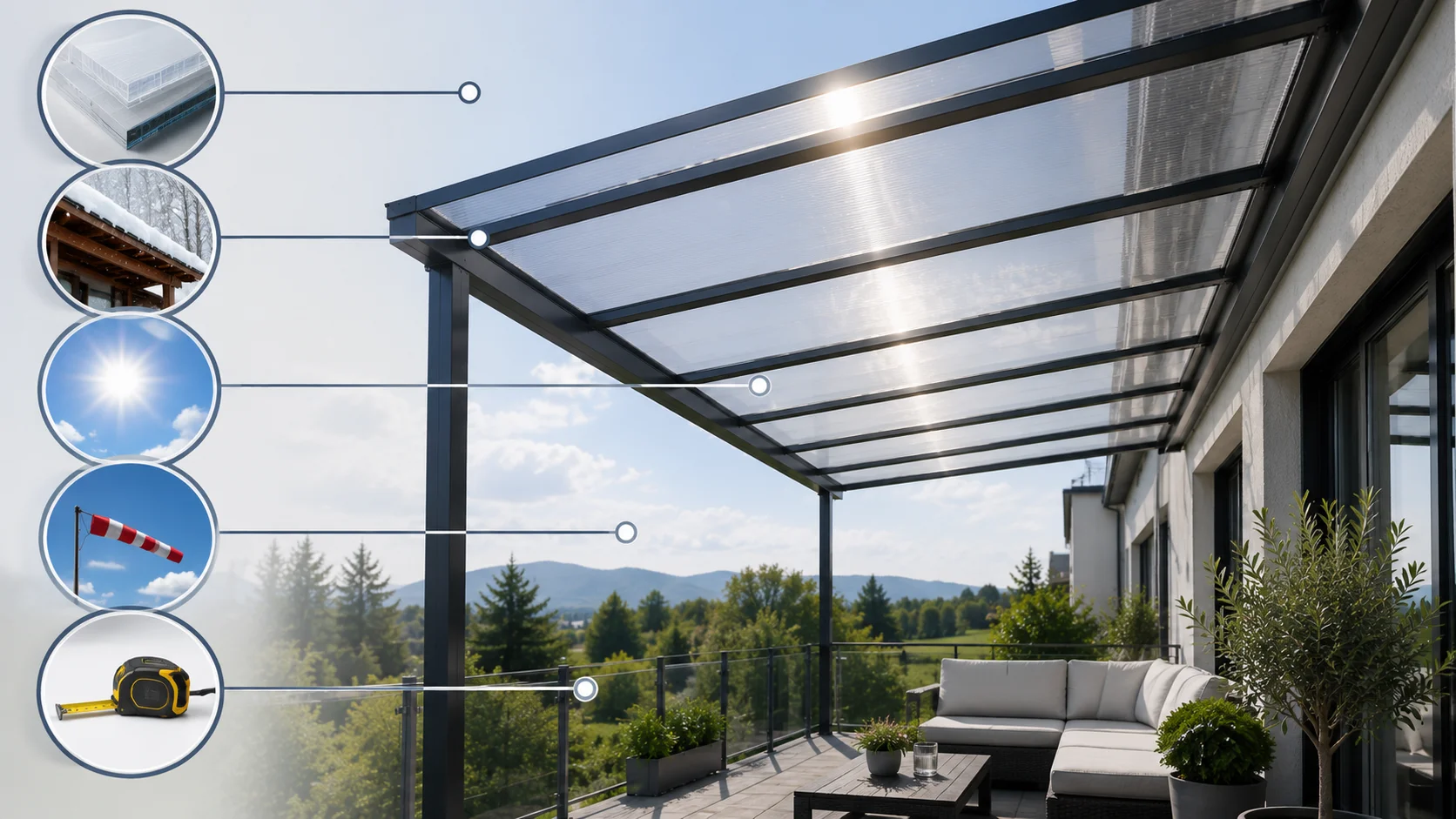
The rule „the thicker the sheet, the better” is an oversimplification. A thicker material usually provides greater rigidity, but it is also heavier and more expensive. Sometimes improving the supporting structure or reducing the spacing between supports is a more sensible solution than automatically choosing the thickest sheet.
Before purchase, it is worth analysing several factors that together determine the correct choice of covering:
- the spacing of rafters and any transverse supports,
- the dimensions and shape of the entire canopy,
- the roof pitch and the method of water drainage,
- local snow and wind loads,
- the type of structure, profiles, seals and fixing points.
Only by considering these parameters together can it be determined whether 6 mm solid polycarbonate will be sufficient or whether an 8 or 10 mm sheet would be a better choice.
Rafter spacing and support area
The greater the distance between rafters, the larger the part of the sheet that remains without direct support. Solid polycarbonate is impact-resistant, but it is still a flexible material. If the spacing is too wide, it may visibly deflect, vibrate in strong winds or place greater strain on the fixing points.
Rafter spacing should be planned together with the thickness and format of the sheet. The joints between sheets should be positioned over stable structural elements, and the entire covering must be supported evenly. Detailed rules are discussed in Oteko’s guide on what rafter spacing for polycarbonate will be suitable for different types of projects.
Size and shape of the canopy
A small canopy above an entrance behaves differently from a wide pergola attached to a house or a freestanding carport. In a small structure, the sheet may be supported over short spans, so a thinner option may be sufficient. With a large roof area, the rigidity of the covering, the quality of the frame and the correct distribution of fixings become increasingly important.
The geometry of the roof also matters. Mono-pitched, curved and multi-pitched structures transfer loads in different ways. Therefore, the thickness used in another project should not be copied without checking whether the support layout and the way the canopy behaves are genuinely comparable.
Roof pitch
The correct pitch helps drain rainwater, wet snow and debris. On a surface that is too flat, water may remain for longer, while in winter heavy snow is more likely to accumulate on the covering. In such a situation, the sheet and fixings are subjected to additional loads that cannot be compensated for solely by increasing the thickness of the material.
If the canopy has a shallow pitch, it is worth allowing a greater margin of rigidity and analysing the support of the entire roof area more carefully. Designing the structure at the limit of the permitted parameters increases the risk of deflection, leaks and accelerated wear of the fixing components.
Snow and wind loads
Weather conditions in Poland vary by region. A structure located where snow remains on the roof for a long time may require a different support arrangement from a similar canopy in a region with milder winters. Wind is equally important, especially for pergolas and shelters installed in open areas.
Strong gusts can cause large sheets to vibrate, while wet snow increases long-term pressure on the surface. In more demanding conditions, it is safer to consider a thicker sheet, closer rafter spacing or both solutions at the same time. For large year-round structures, the parameters should be determined by a design that takes local loads into account.
Type of structure and fixing method
A timber pergola, steel shelter and aluminium roofing system differ in rigidity, the way their elements are joined and their response to temperature changes. This also matters when choosing polycarbonate, because the sheet should be matched not only to the size of the canopy but also to the structure on which it will be installed.
Polycarbonate expands and contracts under the influence of temperature, so an appropriate expansion gap must be left during installation. The sheet must be fixed securely, but it must not be locked too rigidly at the edges or around drilled holes. The profiles, seals, washers and distribution of fixing points are also important.
Even a thick sheet will not perform correctly on a poorly prepared structure. For this reason, choosing the thickness should be the final stage of the analysis, preceded by checking the support spacing, roof area, roof pitch, local loads and installation method.
What thicknesses of solid polycarbonate are used for canopies?
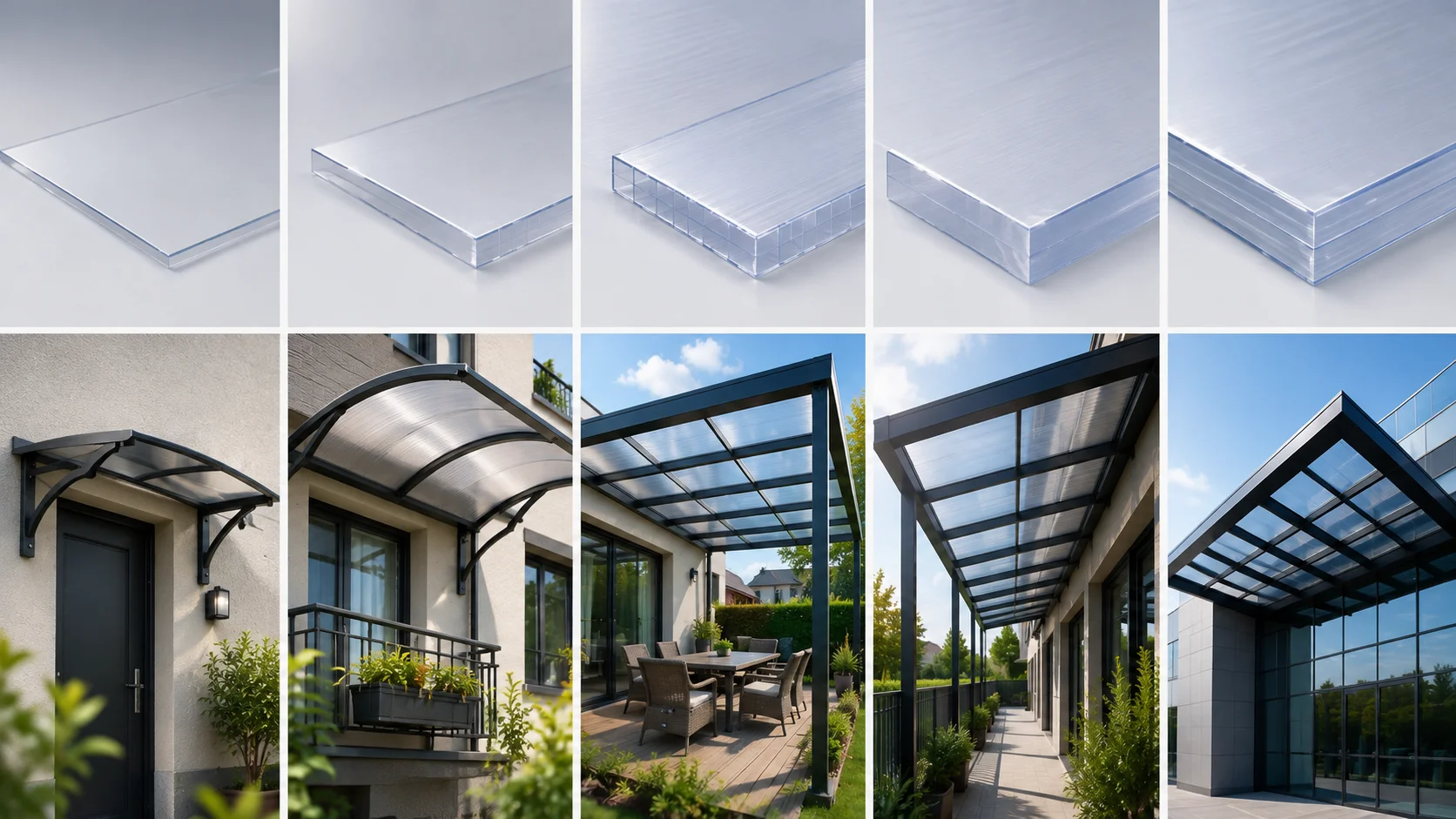
Once the structural parameters have been considered, specific thicknesses can be compared. The individual options differ in rigidity, weight and range of applications, so not every sheet will be suitable for every type of canopy. Thinner materials are primarily suitable for small areas with closely spaced support, while larger structures usually require thicker sheets.
Solid polycarbonate 4 mm
Solid polycarbonate 4 mm may be considered for small canopies, lightweight screens and structures in which the sheet is supported over short spans. This thickness may be suitable above a small entrance, as a protective element or in structures with closely spaced supports.
However, it is not a universal solution for a large terrace. With a wide roof area, widely spaced rafters or a shallow pitch, a 4 mm sheet may be too flexible. In such a project, choosing a thicker sheet or modifying the supporting structure may be more beneficial.
Solid polycarbonate 5-6 mm
Sheets with a thickness of 5 and 6 mm provide an intermediate solution between lightweight screens and larger canopies that require greater rigidity. Solid polycarbonate 6 mm is often chosen for standard terraces and pergolas if the rafters are spaced relatively closely and the roof has the correct pitch.
In a well-planned structure, 6 mm can provide a sensible balance between rigidity, weight, price and ease of installation. However, this does not mean that such a sheet will be suitable for every terrace. With larger sheets or more demanding weather conditions, it is necessary to check carefully whether the structure provides sufficient support.
Solid polycarbonate 8 mm
Solid polycarbonate 8 mm is worth considering for larger canopies, extensive pergolas, shelters and structures with wider spans between supports. A thicker sheet is more rigid than the 6 mm option, so it can reduce visible deflection and excessive movement of the surface.
It is a common choice when the investor does not want to design the covering with only a minimal margin. However, an 8 mm sheet still requires correct rafter spacing, an appropriate pitch and proper fixing. Its greater thickness should not be treated as a way to correct structural errors.
Solid polycarbonate 10 mm
Solid polycarbonate 10 mm is used for larger canopies and projects where high covering rigidity is a priority. It may be suitable for extensive pergolas, carports and year-round structures, provided that the frame has been designed to carry the weight of the sheets and external loads.
The choice of 10 mm should result from the actual requirements of the project. For a small canopy, this thickness may not provide a proportional benefit, while it will increase the material cost and the load on the structure. In a large project, however, it may provide the necessary margin of rigidity.
Solid polycarbonate 6 mm or 8 mm – which should you choose?
Choosing between a 6 and 8 mm sheet is one of the most common dilemmas when planning terrace roofs. A difference of 2 mm may seem small, but over a larger surface area it can have a noticeable effect on the rigidity and performance of the sheet.
Solid polycarbonate 6 mm may be considered when the canopy is small or medium-sized, the supports are spaced relatively closely and the structure has the correct pitch. It is a rational choice for many standard domestic projects.
Solid polycarbonate 8 mm is a safer starting point for a larger terrace, wider rafter spacing, large sheets or a location exposed to wind and snow. A thicker sheet provides a greater rigidity margin, but it should also be selected together with the structure.
The practical rule is simple: 6 mm may be considered for a smaller, well-supported canopy. For a larger roof area, wider support spans or more demanding conditions, the 8 mm option will more often be suitable. If the difference in the overall project cost is small, the greater rigidity margin may be justified.
Does the colour of polycarbonate affect the choice of thickness?
The colour of the sheet does not replace the correct choice of thickness, but it affects the amount of light beneath the canopy, the perceived level of sunlight and the appearance of the entire structure. Clear solid polycarbonate maintains high transparency, which is why it is often chosen for terraces adjoining a living room or other rooms that require good natural light.
In locations exposed to strong sunlight, smoked brown solid polycarbonate or another tinted option may be considered. Such a sheet reduces light intensity and may improve comfort when using the terrace. The choice of option according to the terrace location is discussed in more detail in the guide on which polycarbonate colour is best for a terrace.
Installation is just as important as sheet thickness
Even correctly selected solid polycarbonate may cause problems if it is installed without expansion gaps, on an uneven structure or using unsuitable fixings. The sheets move in response to temperature, so they need room to expand and contract. Holes that are too tight or screws that are overtightened may cause stress around the fixing points.
Before starting work, it is worth checking Oteko’s detailed guide explaining how to install solid polycarbonate correctly. The following rules should be taken into account when planning the canopy:
- Prepare an even, rigid and protected supporting structure.
- Position the supports so that the sheets do not create excessively large, unsupported areas.
- Maintain expansion gaps at the edges and fixing points.
- Use profiles, seals, washers and screws intended for polycarbonate.
- Do not tighten the fixings until the surface of the sheet becomes deformed.
- Install the side with the UV protective layer in accordance with the manufacturer’s marking.
A complete range of polycarbonate accessories helps create stable and watertight joints. When joining larger sheets, appropriately selected aluminium profiles for polycarbonate are also useful.
Solid polycarbonate price and sheet thickness
The price of solid polycarbonate increases with thickness because a thicker sheet contains more material, has greater weight and usually provides higher rigidity. However, the cost of a single sheet should not be compared in isolation. The supporting structure, sheet format and cutting, profiles, seals, fixings and transport also affect the cost of the entire project.
Thinner polycarbonate may appear more economical in the initial estimate, but for a larger canopy it may require closer rafter spacing or additional cross-members. The saving on the sheet will then be partly offset by the cost of the structure. A thicker option is more expensive, but it may provide a greater rigidity margin when used with correctly designed support.
It is best to compare the cost of the entire system rather than only the price per square metre of sheet. For a small canopy, a 4-5 mm option may be reasonable. For a typical terrace roof, 6 mm will often be suitable, while for a larger structure, 8 or 10 mm may reduce the risk of excessive deflection.
Common mistakes when choosing thickness
The most common mistake is choosing a sheet based solely on price. A thin material may be suitable for a small canopy, but it should not automatically be used for a large pergola. Likewise, a thick sheet will not correct rafter spacing that is too wide, an insufficient roof pitch or poorly made joints.
Copying parameters from a random project is also a problem. Even canopies with similar dimensions may differ in location, wind exposure, shape, type of structure and fixing method. As a result, the same thickness may not be appropriate in both cases.
Expansion must not be overlooked either. Polycarbonate moves in response to temperature changes, so its edges and fixing holes must allow for slight movement of the material. Locking the sheet in place with fixings that are too rigid may cause stress regardless of its thickness.
Summary
For a small canopy with closely spaced support, solid polycarbonate 4 or 5 mm may be considered. For a standard terrace roof, 6 mm is a common choice, provided that the structure has the correct pitch and evenly spaced supports. Solid polycarbonate 8 mm provides a greater rigidity margin and is better suited to larger pergolas, shelters and structures exposed to more demanding conditions. Sheets with a thickness of 10 mm are worth using in large and demanding projects whose frames have been properly designed.
The key rule is that the sheet thickness must be matched to the entire canopy. The roof area dimensions, rafter spacing, pitch angle, snow and wind loads and installation method should be analysed together. Before purchasing, it is worth comparing the available thicknesses and formats in Oteko’s range and selecting the sheet together with the full set of components required for stable and watertight installation.