

 August 3, 2026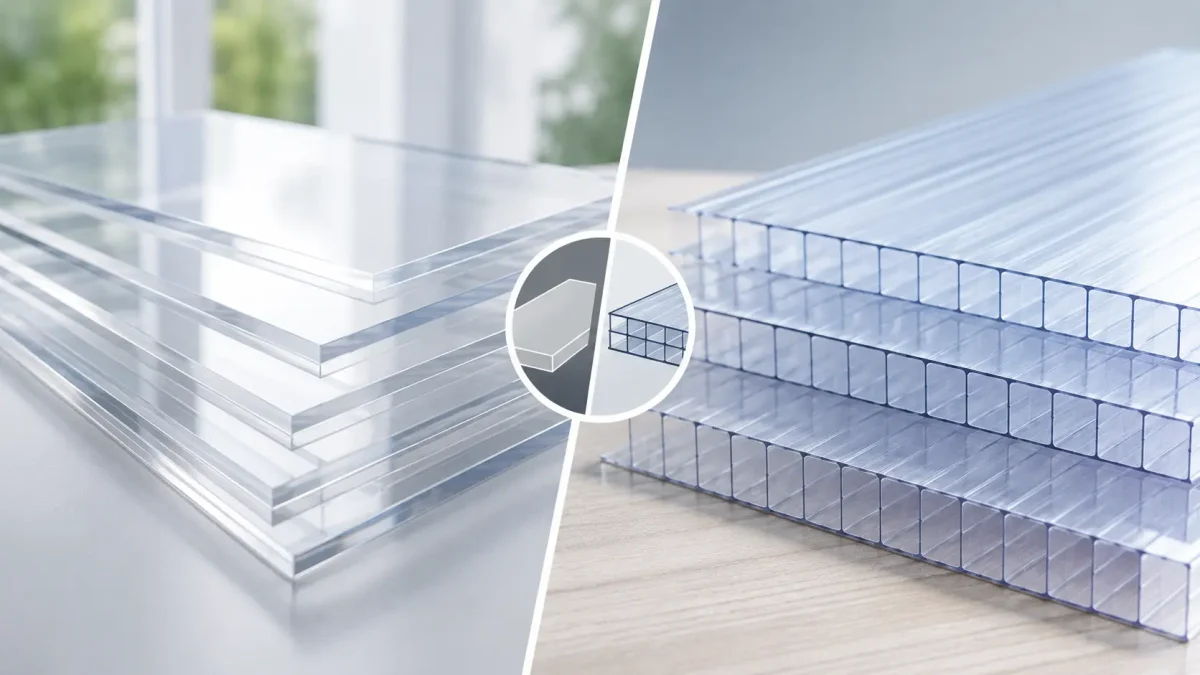
Polycarbonate is a versatile material that combines low weight, durability, and resistance to damage, making it a leading choice in construction and spatial design. Available in two variants – solid and multiwall – each offers unique properties. Are you planning a roof, greenhouse, or protective screen? In this article, we compare solid and multiwall polycarbonate, discuss their advantages and applications, and help you choose the best option for your project.
Solid polycarbonate – strength and transparency
Solid polycarbonate is a uniform, rigid material with an appearance similar to glass, but it is significantly more impact-resistant – up to 200 times more resistant than standard glass. Its high transparency, with light transmission of up to 92% for 2-4 mm sheets, makes it ideal wherever appearance and clarity are important. Its thermoforming capability allows it to be bent and shaped, opening up a wide range of design possibilities.
Advantages of solid polycarbonate
- High transparency comparable to glass, ranging from 88% to 92% depending on thickness.
- Exceptional impact resistance, making it ideal for protective screens.
- Hot-bending capability, allowing the creation of curves and unusual shapes.
- Resistance to UV radiation thanks to a protective coating, providing a service life of up to 20 years.
- Resistance to temperatures ranging from -40°C to +120°C.
Applications
- Protective glazing, such as machine guards in factories.
- Transparent entrance canopies and bus shelters.
- Information and advertising boards requiring high clarity.
- Decorative architectural elements, such as balustrades and rooflights.
Example: Bus shelters made from solid polycarbonate provide transparency and safety while protecting against vandalism due to their resistance to cracking.
Multiwall polycarbonate – low weight and insulation
Multiwall polycarbonate has a multi-chamber structure in which air-filled spaces provide excellent thermal and acoustic insulation. It is lighter than solid polycarbonate, weighing 1.5-5 kg/m² depending on thickness, and is more flexible, making it easier to install in large structures. Although it is less transparent, with light transmission ranging from 50% to 90%, it diffuses light and reduces glare.
Advantages of multiwall polycarbonate
- Excellent thermal insulation, with a U-value of 1.0-3.9 W/m²K, up to three times better than single glazing.
- Low weight, reducing structural loads and transport costs.
- High resistance to weather conditions, including hail and extreme temperatures.
- Light diffusion, making it ideal for greenhouses and roofing.
- Noise reduction, for example in acoustic barriers, reaching up to 30 dB for thicker sheets.
Applications
- Roofing for terraces, gazebos, and car parks, combining an attractive appearance with protection.
- Greenhouses and garden tunnels supporting plant cultivation.
- Rooflights in industrial buildings, helping to save energy.
- Acoustic barriers along motorways, reducing noise.
Example: In greenhouses, 10-16 mm multiwall polycarbonate helps maintain a stable temperature, reducing heating costs by 20-30% compared with glass.
Comparison of solid and multiwall polycarbonate
To make the choice easier, the table below presents the key differences:
| Features | Solid polycarbonate | Multiwall polycarbonate |
|---|---|---|
| Light transmission | 88-92%, high clarity | 50-90%, diffuses light |
| Thermal insulation | U-value of 5.0-5.8 W/m²K, average | U-value of 1.0-3.9 W/m²K, excellent |
| Weight | 4-12 kg/m² for thicknesses of 2-10 mm | 1.5-5 kg/m² for thicknesses of 4-25 mm |
| Impact resistance | Very high, virtually unbreakable | High, but more flexible |
| Flexibility | Rigid, requires thermoforming | Flexible and easy to install |
| Approximate cost | PLN 80-350/m² | PLN 40-180/m² |
Strength
Solid polycarbonate is the preferred choice in places requiring maximum resistance, such as machine guards or bus shelters exposed to vandalism. Its rigidity provides stability but requires precise installation. Multiwall polycarbonate, although also durable, is more flexible and may deform slightly under heavy loads, making it less suitable for extreme protective applications.
Thermal insulation
Multiwall polycarbonate performs better in terms of thermal insulation thanks to its air chambers, which act as a natural thermal barrier. It is ideal for greenhouses, conservatories, and roofing where energy efficiency is a priority. Solid polycarbonate, although durable, provides insulation comparable to single glazing, which limits its suitability for energy-efficient projects.
Which type of polycarbonate should you choose?
The choice between solid and multiwall polycarbonate depends on the requirements of your project:
- Choose solid polycarbonate if: You need maximum transparency and impact resistance, for example for protective screens, entrance canopies, or advertising boards. It is ideal for applications requiring an attractive appearance and durability.
- Choose multiwall polycarbonate if: Low weight and thermal and acoustic insulation are priorities, for example in greenhouses, terrace roofing, or acoustic barriers. It is an excellent choice for large structures and energy-efficient projects.
Tip: When choosing a sheet, consider its thickness, such as 4-6 mm for lightweight roofing or 10-25 mm for greenhouses, as well as the UV coating that extends its service life. Regular maintenance, such as cleaning with a soft cloth, will help preserve the appearance and durability of both types.
Would you like to learn more about maintenance? Read our article “How to care for multiwall polycarbonate” for practical advice.
Summary
Solid and multiwall polycarbonate are modern materials that provide solutions for different construction requirements. Solid polycarbonate offers exceptional transparency and resistance, making it ideal for protective screens and decorative elements, while multiwall polycarbonate stands out for its low weight and insulation properties, making it excellent for roofing and greenhouses. Choose the right variant based on your project requirements to achieve durable and visually attractive results.
Do you have questions or need help choosing polycarbonate? Contact the experts at Oteko.pl – we will help you select the ideal solution for your project.