

 August 3, 2026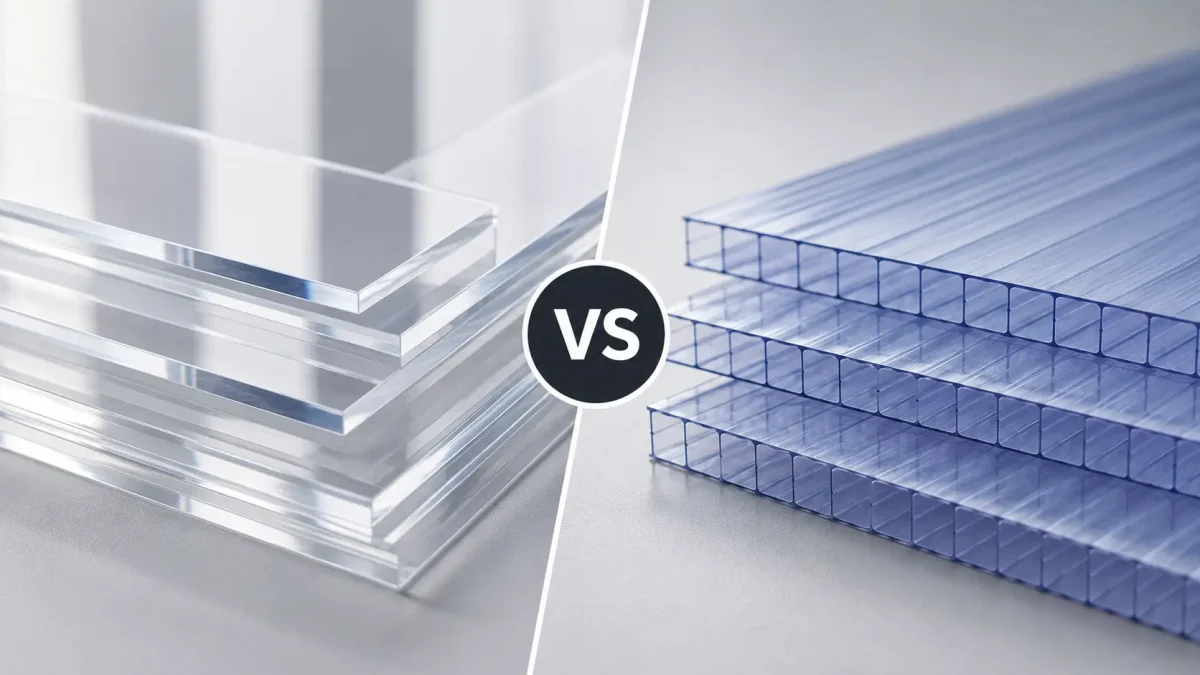
Polycarbonate and plexiglass are two popular plastics that are often compared and sometimes used interchangeably. Although both materials are lightweight, transparent, and suitable for processing, they differ in terms of strength, clarity, rigidity, and typical applications. Understanding these differences makes it easier to choose the best solution for a specific project.
In the following sections, we will compare the key properties of both materials to help determine when plexiglass is the better choice and when polycarbonate is more suitable.
Properties of polycarbonate – what you should know
Polycarbonate is a modern plastic valued primarily for its high impact resistance, low weight, and wide range of applications. In practice, two basic types are most commonly used: solid polycarbonate and multiwall polycarbonate. Both differ in structure, but they share durability, ease of installation, and good functionality in many technical and construction applications.
The most important features of polycarbonate include:
- high impact resistance – the material performs well wherever safety and durability are important,
- lightweight – compared to glass, polycarbonate is much lighter, which makes transport and installation easier,
- thermoplasticity – it can be formed under the influence of temperature,
- good light transmission – especially in the case of clear solid sheets,
- suitability for outdoor use – many sheets designed for exterior applications have a UV protective layer, although this parameter should always be checked in the specification of a particular product.
Solid polycarbonate is a single, uniform sheet without internal chambers. It is characterized by high impact resistance and good transparency, which is why it is sometimes used as a safer alternative to glass. Multiwall polycarbonate, on the other hand, has a multi-layer structure with air channels inside, making it lighter and providing better thermal insulation.
Polycarbonate is used, among others, for roofing, shelters, skylights, protective covers, technical partitions, and garden structures. When installing sheets designed for outdoor use, it is important to remember that proper cutting, fastening, and allowing for the material’s thermal expansion are also crucial. More information about this can be found in the guides: how to properly install solid polycarbonate and a practical guide to installing multiwall polycarbonate.
Properties of plexiglass – lightness and clarity in practice
Plexiglass, also known as acrylic glass or PMMA, is a plastic valued for its very high transparency, aesthetic appearance, and ease of processing. The material is lightweight, rigid, and often used where visual qualities and good light transmission are important.
The main advantages of plexiglass include:
- very high transparency – the material allows light to pass through well and provides an attractive visual effect,
- lightweight – it is significantly lighter than glass,
- rigidity – it maintains its shape well and works well in many decorative and display applications,
- easy processing – it can be cut, milled, formed, and bent,
- good weather resistance – plexiglass also performs well in many outdoor applications.
Plexiglass is widely used in advertising, displays, showcases, furniture, decorative covers, and interior design elements. It is primarily chosen for applications where transparency, aesthetics, and ease of shaping are the most important factors.
Main differences between polycarbonate and plexiglass
Although both materials are often compared as alternatives to glass, in practice they work best in slightly different applications. The key differences relate to impact resistance, transparency, rigidity, processing methods, and typical uses.
1. Strength and resistance to damage
This is one of the most important differences between these materials.
- Plexiglass – it is a rigid and aesthetically pleasing material, but it can crack or chip under strong impact.
- Polycarbonate – it withstands impacts much better and is therefore more often used where durability and safety are important.
If the material will be used in a place exposed to mechanical damage, polycarbonate is usually the safer choice.
2. Material processing
Both plexiglass and polycarbonate can be processed, but each behaves slightly differently during cutting, drilling, or forming.
- Plexiglass – works well where an aesthetic finish and precise machining are important, but it requires care during drilling and work near edges.
- Polycarbonate – handles mechanical processing well and is less prone to cracking during installation, which is why it often performs better in structural applications.
3. Resistance to weather conditions
Both materials can be used outdoors, but it is important to pay attention to the parameters of the specific sheet and its intended use.
- Plexiglass – performs well in many outdoor applications and maintains its aesthetic appearance for a long time.
- Polycarbonate – also works well outdoors, especially in versions designed for such use and equipped with UV protection.
In practice, for both materials it is best to rely on the product specification rather than only the general name of the plastic.
4. Transparency
Plexiglass and polycarbonate also differ in optical properties.
- Plexiglass – usually offers very high transparency and is often chosen where visual effect is important.
- Polycarbonate – can also be very transparent, especially in the solid version, but the exact level of light transmission depends on the type of sheet, its thickness, color, and structure.
It is worth remembering that multiwall polycarbonate and solid polycarbonate are two different solutions, so they should not be evaluated identically in terms of transparency.
5. Applications
In most cases, the intended application determines the choice between these materials.
- Plexiglass – mainly used in advertising, displays, interior design, showcases, decorative covers, and elements where aesthetics and clarity of the material are important.
- Polycarbonate – more often chosen for roofing, protective covers, shelters, skylights, partitions, and structures where higher impact resistance and durability are required.
Which to choose – polycarbonate or plexiglass?
The choice between these materials depends mainly on the requirements that the final structure must meet.
Polycarbonate will be the better option when the priority is strength, impact resistance, safety, and use in more demanding conditions. Plexiglass works best when high transparency, aesthetics, and ease of producing decorative or display elements are the most important factors.
Simply put: if mechanical resistance is more important, polycarbonate is usually the better choice. If appearance and transparency are more important, plexiglass is often the better option.
Conclusions
Polycarbonate and plexiglass are two different materials with distinct strengths. Polycarbonate performs better where impact resistance and durability are required, while plexiglass is more often chosen for projects where aesthetics, rigidity, and high transparency are the priority.
To select the right material, it is worth considering not only the name of the plastic but also the specific type of sheet, its thickness, the installation method, and the conditions in which it will be used.