


 August 3, 2026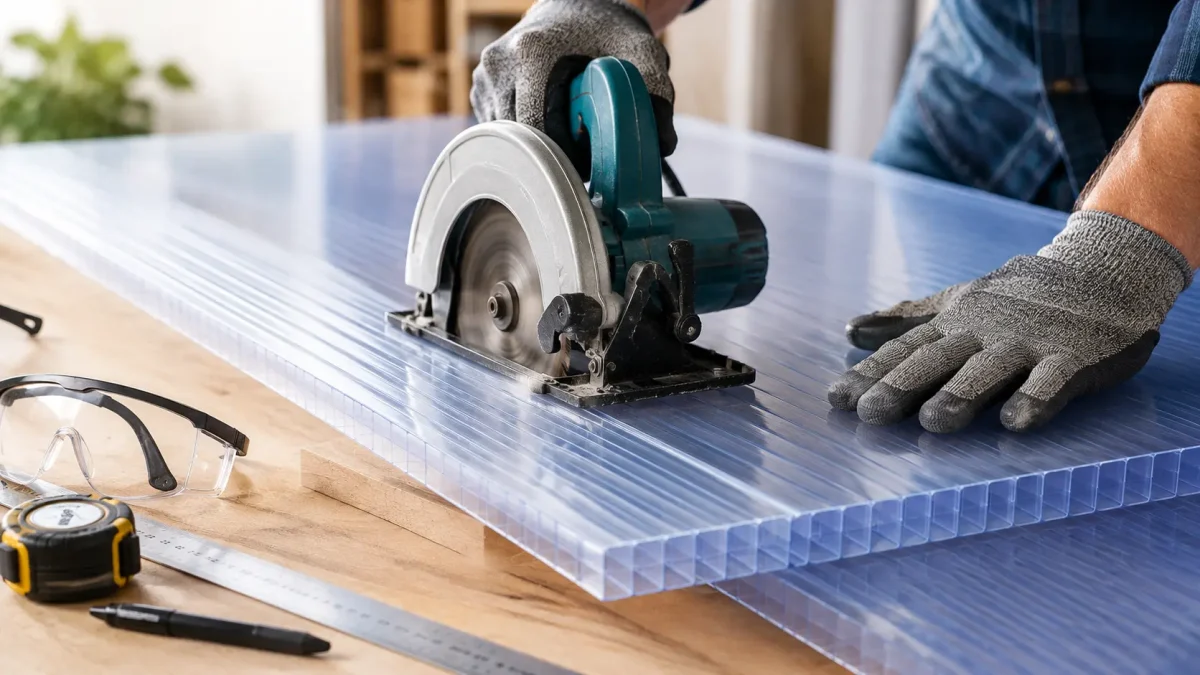
Multiwall polycarbonate is one of the most commonly chosen materials for lightweight canopies, greenhouses, partitions, and other structures where low weight and good durability matter. In practice, sheets are rarely used in their factory size, so proper cutting affects not only the appearance of the edge but also installation quality and the long-term performance of the whole structure.
The right cutting method depends mainly on sheet thickness, the scale of the work, and the level of precision required. The most common options are a circular saw, a utility knife, and CNC machining. Each of these tools works best in different conditions, so before you start, it is worth preparing the sheet properly and matching the cutting method to the intended application.
What is multiwall polycarbonate and why is it so often used in lightweight structures?
Multiwall polycarbonate is a lightweight construction material with a layered internal structure. Inside the sheet there are air chambers formed by a system of ribs, which gives the material a good balance between low weight and structural rigidity and makes it suitable for outdoor use.
This multiwall structure is responsible for the material’s key advantages. The sheets are noticeably lighter than many alternative glazing materials while still handling typical service loads well. They also allow light into the space and help create structures that look visually light and modern.
In many lightweight applications, multiwall polycarbonate is more practical than solid polycarbonate, mainly because it weighs less and is easier to install. Before cutting, however, it is important to remember that the method should be matched not only to the sheet thickness but also to the chamber direction and the intended use of the finished element.
Main applications of multiwall polycarbonate
This material is widely used in:
- terrace roofs, carports, and pergolas,
- greenhouses and crop covers,
- skylights and lightweight enclosures,
- partitions and structural infill panels,
- various garden and utility projects.
How to prepare the sheet before cutting
Before starting, it is worth preparing the sheet properly, because even a good tool will not give a clean result if the panel is unsupported or unstable. First, mark the cutting line carefully, then place the sheet on a flat, stable surface. The sheet should not bend or vibrate during cutting.
In practice, it is best to follow a few simple rules:
- mark the cutting line precisely with a marker and a guide,
- support the entire sheet firmly, especially near the cutting line,
- secure the material if there is any risk of movement,
- remove chips and dust from inside the chambers after cutting.
This stage often determines the final result. A properly prepared sheet is easier to process, and the risk of chipped edges, crushed chambers, and uneven cutting is much lower.
Cutting multiwall polycarbonate with a circular saw

One of the most common ways to cut multiwall polycarbonate sheets is with a circular saw. This method is especially useful when you need long, straight cuts and accurate fitting of sheets to the structure.
To achieve a clean and even edge, choosing the right blade is essential. Blades with fine teeth designed for plastics or aluminium usually work best. Teeth that are too aggressive may cause edge chipping and damage the thin chamber walls.
When working with a circular saw, pay attention to several important points:
- moderate rotational speed – excessively high speed can overheat the material and melt the edge,
- steady and controlled feed – forcing the saw forward increases vibration and the risk of an uneven cut,
- stable support across the whole sheet – the panel should lie on a flat surface to avoid bending.
Properly securing the material is also very important. Vibrations can reduce cutting quality and make it harder to keep a straight line. Clamps or guides are often useful because they improve stability during work.
After cutting, remove chips from inside the chambers. This is especially important if the sheet will later be installed with profiles and edge protection accessories.
When using a circular saw, safety rules should never be ignored. Safety glasses, work gloves, and a stable workstation are essential.
Cutting multiwall sheets with a utility knife
For thinner multiwall polycarbonate sheets, a utility knife can be a simple and effective option. This method is best suited to small installation jobs and short, straight cuts.
To get a neat edge, the blade must be very sharp. A dull blade may tear the material, crush the chambers, and leave an uneven finish. In practice, it is better to make several controlled passes along the marked line than to try cutting the sheet through in one motion.
How to cut with a utility knife correctly
- Mark the cutting line precisely – preferably using a metal ruler or straight guide.
- Place the sheet on a stable surface – the base should be hard and level.
- Guide the blade slowly and evenly – without applying excessive force.
- Deepen the cut gradually – after several passes, the sheet can be snapped carefully along the scored line.
This technique works mainly for thinner sheets and straight sections. For thicker panels or more demanding shapes, a power tool is usually the better choice.
Although this is a relatively simple method, caution is still necessary. Stable blade control and protective gloves significantly reduce the risk of injury.
Machining multiwall polycarbonate with a CNC router
For projects that require high accuracy and repeatable results, a CNC router is a very good solution. Computer-controlled machining makes it possible to process the material according to a prepared design with a high level of consistency.
Multiwall polycarbonate can be machined effectively and accurately, provided the settings are chosen properly. The spindle speed, feed rate, and cutter type all matter. A tool designed for plastics is the safest choice. If the machining is too aggressive, the edges may overheat and start to melt.
Advantages of CNC cutting
- very high cutting accuracy,
- the ability to produce more complex shapes,
- excellent repeatability in serial production,
- clean and even edges.
A CNC router can be used not only for straight cuts but also for curves, mounting holes, and custom cut-outs. For this reason, it is mainly used in professional processing and in projects where the final shape must closely match the design.
Which tools should you choose for cutting multiwall polycarbonate?
The right cutting method depends mainly on the sheet thickness, the scale of the work, and the level of precision required. One solution may be ideal for a home canopy project, while another will be better for more demanding applications.
The most commonly used tools are:
- circular saw – best for long, straight cuts and thicker sheets,
- utility knife – suitable for thinner sheets and shorter cuts,
- CNC machines – used when high precision and repeatability are required.
Regardless of the chosen method, cutting is only one stage of working with the material. Proper installation is just as important, including suitable profiles, edge finishing, and correct chamber sealing. For more advanced projects, it is worth using polycarbonate accessories and matching installation components to the structure.
If you plan to install the sheet in a greenhouse, canopy, or lightweight enclosure after cutting, it is also worth reviewing the basic installation rules. Useful guidance can be found here: installation guide for multiwall polycarbonate sheets.
Most common mistakes when cutting multiwall polycarbonate
Even a good tool will not guarantee a proper result if basic mistakes happen during the process. In most cases, the problem is not the material itself but the cutting technique.
- using a dull blade or the wrong saw blade,
- failing to support the sheet properly,
- feeding the tool too quickly or using excessive speed,
- leaving chips and dust inside the chambers,
- choosing a cutting method that does not match the sheet thickness.
Avoiding these mistakes helps produce a cleaner edge, reduces the risk of damage, and makes installation easier.
Summary
Multiwall polycarbonate is a practical material for lightweight structures, but only when it is cut and installed correctly. The key is to match the cutting method to the sheet thickness and maintain stable working conditions throughout the process.
A circular saw is usually the best option for long, straight cuts, a utility knife can work for thinner sheets, and CNC machining is worth considering for more demanding projects. Regardless of the method, accuracy, caution, and proper preparation of the material have a direct impact on the final result.