


 August 3, 2026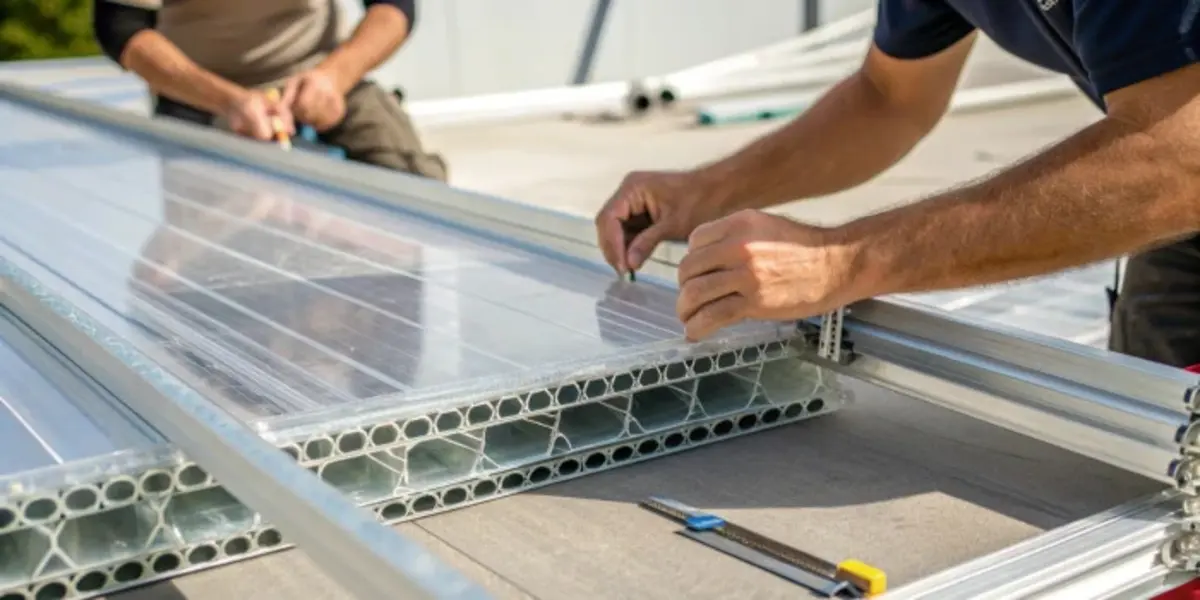
Joining multiwall polycarbonate sheets affects the watertightness, durability and appearance of the entire structure. This material has internal chambers, which means its edges and joint areas require more attention than ordinary solid sheets. If the joint is made carelessly, moisture, dust and insects can get inside, and the canopy, greenhouse, carport or partition will lose its clean appearance much sooner.
The problem is not only leakage itself. Poorly joined sheets can move unevenly, deform with temperature changes or transfer stress to the supporting structure. That is why, when installing multiwall polycarbonate, it is important to think not only about keeping the sheets in place, but also about how they will behave after several months of outdoor use.
Why is proper joining of multiwall polycarbonate so important?
Multiwall polycarbonate differs from solid sheets because it has internal channels. These channels make the material lightweight and provide good insulation, but they also mean that open edges need to be protected. If the chambers are left unprotected, moisture, dust, fine dirt, small insects and other contaminants can get inside and become difficult to remove later.
The joint between sheets is one of the most sensitive parts of the whole structure. This is where leaks, sheet displacement, uneven pressure or stress formation most often occur. In canopies, carports, greenhouses and protective wall panels, such mistakes may not be visible immediately, but only after rain, strong wind, frost or a longer period of material movement in the sun.
Thermal expansion is also important. Polycarbonate changes its dimensions under the influence of temperature, so it should not be fixed too rigidly. If the sheets are installed without space for the material’s natural movement, they may start to ripple, press against the profiles or move in a way that weakens the joint over time.
Proper joining is therefore not only a matter of appearance. It affects watertightness, stability, durability and the ease of later use of the structure. Well-protected edges and correctly made joints help reduce dirt inside the chambers, lower the risk of leaks and allow the sheets to retain their proper appearance for longer.
How to join multiwall polycarbonate?

Joining multiwall polycarbonate should be based on suitable installation elements, not on simply placing two sheets next to each other. Every joint must stabilise the material, protect the open chambers and allow the sheet to move with temperature changes. If any of these elements are missing, the structure may look correct immediately after installation, but leaks, dirt or stress may appear over time.
To join sheets correctly, the following elements are usually needed:
- joining profiles matched to the sheet thickness;
- tapes for protecting open edges;
- end profiles for protecting the edges;
- screws and washers suitable for polycarbonate;
- space for the material’s thermal expansion;
- clean, evenly cut edges;
- a stable supporting structure.
Each of these elements performs a different function. The profile is responsible for joining and supporting the sheets, the tape protects the chambers from dirt and moisture, and the correct fixings hold the material in place without excessive pressure. That is why system solutions should not be replaced with random strips, ordinary tape, glue or silicone if the structure is meant to be durable and resistant to outdoor conditions.
It is also important to match the joining method to the intended use. A small protective partition works differently from a terrace canopy, and differently again from a greenhouse or carport exposed to wind, rain and snow. The larger the sheet surface and the greater the load, the more important stable profiles, proper support and space for the natural movement of polycarbonate become.
Profiles for multiwall polycarbonate – what function do they perform?

Profiles for multiwall polycarbonate organise the joint between sheets, stabilise the edges and help maintain the watertightness of the structure. They are not only an aesthetic addition. A poorly chosen profile can cause looseness, uneven pressure, leaks or damage to the sheet edge. That is why the profile should be matched to the thickness of the polycarbonate, the type of structure and the conditions in which the material will be used.
Joining profiles
Joining profiles are used to connect adjacent sheets in one plane. They prevent the edges from being left loose next to each other and make the joint more orderly and stable. With multiwall polycarbonate, this is especially important because the open edges of the sheets are vulnerable to dirt, moisture and mechanical damage.
The joining profile should match the sheet thickness. If it is too tight, it may cause stress and restrict the material’s natural movement; if it is too loose, it will not provide adequate support. In practice, it is worth choosing accessories for polycarbonate designed for a specific type of sheet instead of using random strips or elements only roughly matched to the installation system.
Pressure profiles
Pressure profiles are especially useful where sheets are exposed to rain, wind, snow or heavier loads. Their task is to hold the polycarbonate securely on the supporting structure and reduce the risk of wind uplift, movement or uneven contact between sheets and the frame. In such areas, a light joint alone may be insufficient.
Good pressure does not mean tightening everything as much as possible. Polycarbonate should be held in a controlled way, but not compressed so strongly that it cannot move under the influence of temperature. Fixing it too rigidly may lead to stress, rippling or cracking around installation points.
End profiles
End profiles are used on the open edges of sheets. Their function is different from joining profiles: they are not primarily used to connect two sheets, but to protect the edges and the sealing tapes. Thanks to them, the sheet edge is less exposed to dirt, accidental damage and an untidy finish.
With multiwall polycarbonate, closing the edges is very important because the chambers should not remain open. An end profile helps cover the tape, improves the appearance of the edge and reduces contact between the edge and water or dirt. This is especially important for canopies, partitions and other elements visible at close range.
Tapes for multiwall polycarbonate – why are they needed?

Tapes for multiwall polycarbonate are not used to structurally join sheets. Their main purpose is to protect open chambers from dirt, moisture, dust and insects. This is important because, once the sheet is installed, contaminants inside the chambers are difficult to remove and may permanently worsen the appearance of the whole structure.
Open edges should not be left unprotected on multiwall sheets. Even if the joint looks neat immediately after installation, the open chambers will quickly start collecting dust, water and deposits. That is why tapes should be treated as an essential installation element, not as an optional addition used only in more demanding structures.
Solid tape
Solid tape is most often used on the upper edge of the sheet. Its task is to seal the chambers from the side where water, dust, dirt and small insects could enter. This gives the upper part of the sheet better protection against contamination and helps the chambers retain a clean appearance for longer.
However, solid tape should not be treated as a universal protection for every edge. If it is used in the wrong place, it may make it harder for moisture to leave the inside of the chambers. That is why it is important to distinguish between the upper and lower edge of the sheet and choose the tape according to the function it must perform in a particular area.
Perforated tape
Perforated tape is usually used on the lower edge of the sheet. Its task is to protect the chambers against insects and larger dirt particles while allowing moisture that may appear inside to escape. This is particularly important in outdoor structures, where temperature changes encourage condensation.
The lower edge should not be closed with solid tape if moisture needs a way to leave the chambers. Trapped water vapour may cause fogging, deposits and a deterioration in the sheet’s appearance. Perforated tape helps reduce this problem because it protects the inside of the chambers without completely blocking their ventilation.
Installation without tapes – what can go wrong?
Leaving open edges without tapes is one of the most common mistakes when installing multiwall polycarbonate. At first, the sheet may look correct, but over time dust, moisture, insects and fine dirt begin to enter the chambers. As a result, the material loses transparency, and darker streaks, deposits or greenish marks may appear.
The problem is that dirt inside the chambers is practically inaccessible after installation. It cannot be easily rinsed out or cleaned without removing the sheet, and sometimes even disassembly does not restore the original appearance. That is why the edges should be protected with tapes immediately, before the sheets are fixed into the structure.
What should you watch out for when joining sheets?
When joining multiwall polycarbonate, profiles and tapes are not the only important elements. The way the sheets are positioned and the space left for their natural movement also matter. Even well-chosen installation components will not perform their function if the sheets are laid in the wrong direction or fixed too tightly. In practice, most problems appear when these seemingly small details are overlooked.
Expansion gap
Polycarbonate changes its dimensions under the influence of temperature. In hot weather it may expand, while at lower temperatures it may contract. That is why sheets should not be installed rigidly, without space for the material’s natural movement. Lack of an expansion gap can lead to stress, rippling, cracking around fixing holes or loss of watertightness at the joints.
An expansion gap is especially important on larger surfaces, such as canopies, carports, skylights or long protective wall panels. The larger the sheet, the more visible its movement may become during temperature changes. Profiles and fixings should therefore stabilise the material without blocking it completely.
Direction of the chambers
The direction of the chambers affects whether moisture can flow down freely. In vertical or sloped installations, the channels should be positioned in line with the fall so that condensation does not remain inside the sheet. If the chambers are placed horizontally in an area where water should drain away, moisture may stay inside and worsen the appearance of the material.
It is also important to pay attention to the side with UV protection. In outdoor installation, it should face the sun, because this layer protects the sheet from accelerated degradation. This should be checked before removing the protective film and finally fixing the sheets; the guide which side of polycarbonate should face outwards explains this in more detail.
The most common mistakes when joining multiwall polycarbonate

Mistakes in joining multiwall polycarbonate are often not visible immediately after installation. The structure may look correct for the first few days, but problems appear later: after rain, during hot weather, in strong wind or after several cycles of expansion and contraction. They most often result from treating a multiwall sheet like an ordinary solid sheet, without taking its structure and thermal movement into account.
The most common mistakes include:
- joining sheets edge to edge without a profile;
- using profiles that do not match the sheet thickness;
- leaving open chambers without protective tape;
- closing the lower edge with solid tape, which blocks moisture drainage;
- not using an end profile on exposed edges;
- positioning the chambers in a direction that traps water or condensation;
- omitting the expansion gap;
- tightening screws too much and deforming the sheet;
- using random silicones, glues or tapes instead of system components;
- treating tape as a substitute for a joining profile;
- removing the protective film too early, making the sheet easier to scratch during work.
The most problematic mistakes are those that trap moisture inside the chambers or block the material’s natural movement. Over time, they may lead to dirt build-up, fogging, sheet rippling, leaks or damage around fixing points. That is why, when joining multiwall polycarbonate, installation should not be simplified at the expense of profiles, tapes and the correct expansion gap.
How to check whether the sheet joint has been made correctly?
After joining the sheets, it is worth checking not only whether the structure looks even, but also whether the most important areas are protected against water, dirt and stress. A correctly made joint should hold the sheets securely, but it must not compress them so strongly that the material has no space to move under the influence of temperature.
On the finished joint, it is worth checking:
- whether the profiles match the sheet thickness;
- whether the sheets have not been forced into the profiles;
- whether open chambers are protected with suitable tapes;
- whether the lower edge allows moisture to drain away;
- whether exposed edges are closed with end profiles;
- whether the fixing does not deform the sheet surface;
- whether the joint is not rippling, lifting or showing visible stress;
- whether the side with UV protection faces outwards;
- whether the sheets have space to expand and contract under temperature changes.
It is also worth inspecting the joints after the first rain and after a few warmer days. This makes it easier to see whether water is collecting near the edges, whether the profiles fit properly and whether the sheets are starting to move in an uncontrolled way. If looseness, leaks or stress appear, it is better to correct them immediately before they cause permanent damage to the sheet or the structure.
Suitable screws, washers and tightening method are also important when fixing the sheets. Excessive pressure may damage polycarbonate, while fixings that are too loose will not provide stability in windy conditions. The guide on which screws to use for multiwall polycarbonate explains more about choosing suitable fixing elements.
Summary
Joining multiwall polycarbonate requires installation elements to be matched to the structure of the sheet and to the conditions in which the construction will be used. The most important steps are protecting open chambers, using suitable profiles, leaving space for thermal expansion and checking the direction of the channels.
Profiles are responsible for a stable and neat connection between sheets, while tapes protect the chambers from dirt, moisture and insects. They should not be treated as interchangeable because they perform different functions. Tape alone will not replace a joining profile, and a profile alone will not properly protect open chambers without the correct tape.
Most problems result from shortcuts: joining sheets directly edge to edge, ignoring the expansion gap, overtightening screws, using random profiles or leaving edges unprotected. A correctly made joint is more watertight, more durable and better protects multiwall polycarbonate against dirt and damage during use.